

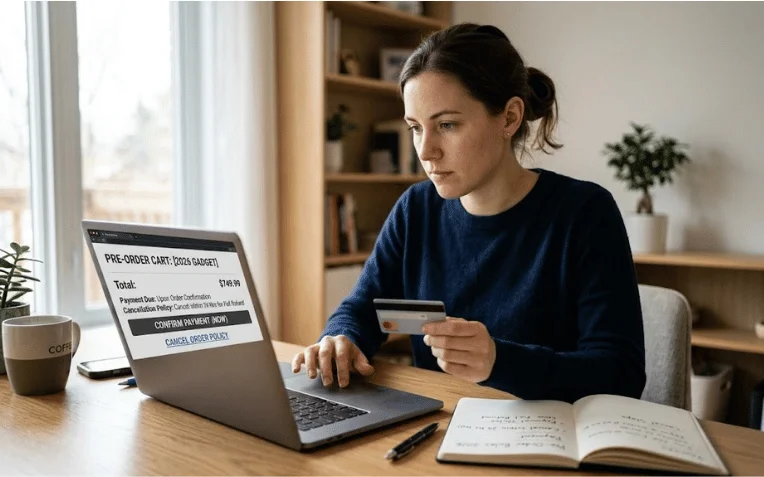
You are about to hand over money for something that does not exist yet. Two questions decide whether that is smart or careless: when does the cash actually leave your account, and what happens if the release date moves? Most product pages answer neither.
Stores write it as pre-order, pre-order, and preorder, and all three mean the same thing. You are reserving a unit before it ships. What changes from store to store is the payment timing and how easily you can walk away. This guide reads the small print from the buyer’s side, not the seller’s.
Short answer: most US retailers authorize your card when you order and charge it when the item ships, or a few days before release. Digital stores take payment closer to launch. You can usually cancel a physical order free until it ships, and federal rules back a refund if delivery slips.
Table of Contents
Pre-order terms compared across the big stores
Policies differ more than the product pages suggest. Here is how the platforms most Americans use actually behave, by category.
| Where you buy | When the money leaves | Canceling before release | If the price drops |
|---|---|---|---|
| Amazon (books, games, gadgets) | Authorization hold at order, charged as it ships, usually on or just before release day | Free online until the order enters shipping | Pre-order Price Guarantee: you pay the lowest Amazon price between your order and the end of release day, on eligible items sold by Amazon |
| Best Buy (consoles, TVs, phones) | Reauthorized near release, charged as the order ships or is ready for pickup | Free until final processing starts | You are billed the lower of your order price and the price at shipment |
| Apple (iPhone, Mac, iPad) | Hold at order, charged when the order moves to preparing to ship | Free until it ships | No named guarantee, and launch pricing rarely falls anyway |
| PlayStation Store (digital games) | Charged at checkout for digital titles, at shipping for PlayStation Direct hardware | Refundable up to release day if you ordered 14 or more days ahead and have not downloaded it | You keep the price you paid |
| Steam (pre-purchase) | Charged immediately at checkout | Refundable any time before Advanced Access or launch begins | No automatic adjustment |
| Nintendo eShop (digital) | Payment processed no earlier than seven days before release | Free until that payment runs | Price locks at checkout |
| Barnes & Noble (books, vinyl) | Authorization at order, then a second authorization and the real charge when stock lands | Free before it ships | Billed at the price when it ships |
| GameStop (in-store) | Deposit at the counter, balance at pickup | Deposit refundable under store policy | No formal guarantee |
TL;DR
- An authorization hold is not a charge. It fences off funds and often disappears before the real payment lands.
- Physical reservations are the low-risk ones. You can nearly always back out before the box moves.
- Digital ones carry the real risk. Money frequently moves at checkout, and the refund windows are short.
- If a seller misses the shipping date it promised you, federal rules give you the choice: agree to wait, or take your money back.
- Bonus content is worth whatever a cosmetic item is worth to you. That is usually less than the price protection you give up.
When a pre-order charges your card


Three payment models cover almost everything you will meet. Full payment at checkout is standard for digital goods. A deposit, typically ten or twenty dollars, is what physical game stores take at the counter. Authorization only, where the store checks your card but takes nothing, is what most large online retailers use for physical goods.
That third model is where people panic. Your banking app shows a pending amount within minutes, so it looks like you paid. You did not. The hold reserves the funds, and on a launch three months out, it usually expires and reappears later, closer to the ship date. Two lines on a statement for one item is normal, and Barnes & Noble spells that out for its own orders.
A practical note: use a credit card rather than a debit card. A hold against a checking balance ties up real money for weeks, and the store will not cover an overdraft that results. Remember too that nothing exists yet. You are judging a spec sheet and a set of images, and sharp professional product photography can make a launch look finished months before the factory agrees.
What happens if the release date slips
This is the scenario buyers worry about, and the one almost no explainer covers. US shoppers are not relying on goodwill here. The FTC’s Mail, Internet or Telephone Order Merchandise Rule, known as the 30-Day Rule, sets the floor.
A seller must have a reasonable basis for the shipping window it advertises. If it states no window, the default is 30 days. Miss it, and the seller has to tell you, give you a revised date, and explain that you may cancel for a prompt, full refund. For a definite delay of up to 30 days, your silence can count as agreement. For anything longer, indefinite, or a second delay, the seller needs your active yes. Without it, the money must come back without you asking.
Two details matter. A refund means a refund, not store credit or a gift card. And the store may cancel your order itself, provided it tells you promptly and pays you back.
How much right to cancel do you really have
Physical goods are simple. Until the item leaves the warehouse, you can cancel from your account page and the pending hold falls away within a few business days. Digital goods are where the fine print bites.
- Steam: refundable at any point before Advanced Access or launch starts. After that, the usual 14 days and two hours apply, with the 14 days counted from release rather than from your purchase. Since 2024, hours played during early access count against that two-hour limit.
- PlayStation: digital orders placed 14 or more days before launch can be refunded right up to release day, as long as you have not started the download.
- Nintendo eShop: cancel free until payment runs, which is no earlier than a week before launch.
- Xbox and most storefronts: refunds are discretionary once the charge clears, and a broken launch is your strongest argument.
The reverse happens too. Stores sometimes cancel on you, because allocation for a hyped console never matched the number of orders they took. That is a forecasting failure, and it is why smarter inventory planning shows up in your inbox as an apology email on launch morning.
Do you get the lowest price?

Sometimes, and only at two of the big names. Amazon’s Pre-order Price Guarantee charges you the lowest price it listed between your order and the close of release day, on qualifying items it sells itself. Marketplace sellers are excluded, which catches out a lot of collectors buying trading cards and figures. Best Buy takes a similar line and bills the lower of your order price and the shipping-day price.
Everywhere else, the number you agreed to is the number you pay. Screenshot the price and the promised ship date the day you order. If the price falls before release at a store with no guarantee, cancel and rebook at the new price. That takes about ninety seconds and is the single most useful habit in this whole article.
Are pre-order bonuses worth the money?
Honestly, rarely. A bonus skin, a soundtrack download, or a steelbook costs the publisher almost nothing. It buys something far more valuable: a sales number on day one and the brand awareness a launch needs before reviews land. Plenty of exclusive items resurface later as paid downloadable content or in a complete edition at half the price.
There are three cases where the bonus genuinely earns its place. A limited physical run that will not be reprinted, such as a collector’s edition or a first-pressing vinyl. A launch with real scarcity, where consoles vanish for six months. And a small studio where your early payment helps the project reach the finish line.
Early access is the one bonus that now carries a cost. Playing during that window on Steam eats into the two hours you would otherwise have for a refund.
So should you reserve it or wait?
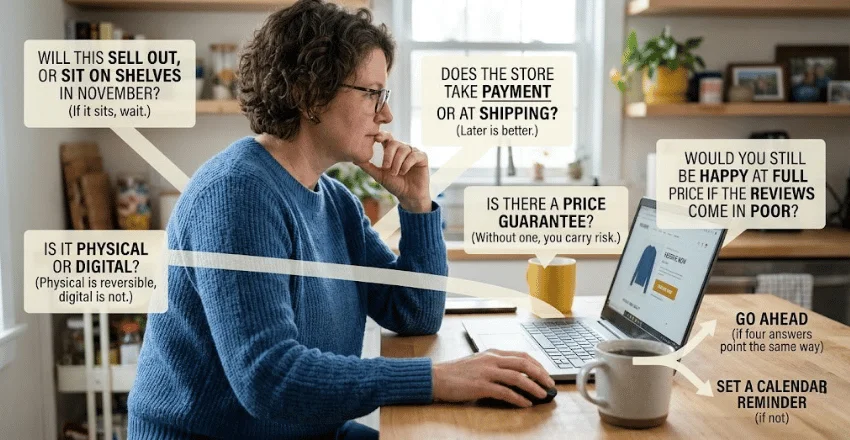
Run through five questions before you click.
- Will this sell out, or will it sit on shelves in November? If it will sit, wait.
- Is it physical or digital? Physical is reversible; digital often is not.
- Does the store take payment now or at shipping? Later is better for you.
- Is there a price guarantee? Without one, you carry the risk of every discount that follows.
- Would you still be happy at full price if the reviews come in poor?
If four of those answers point the same way, go ahead. If they do not, set a calendar reminder for release week and buy with reviews in front of you. Save this page, then check your next order confirmation against the table above before the charge lands.
If you want to know about Wellness at Work then visit our Business category.
Pre-order FAQ
Usually not for physical goods. Large US retailers place an authorization hold and take payment when the item ships or a few days before release. Digital stores are the exception, and Steam charges at checkout.
Once payment clears, you are into the store’s returns policy rather than a free cancellation. For physical goods, you can usually refuse delivery or return the item unopened. For digital purchases, check the platform’s refund window first.
Contact the seller and ask for the refund the FTC rule requires. If that goes nowhere, dispute the charge with your card issuer and file a report with the FTC. Keep the order confirmation and the promised ship date.
No. It puts you in the queue and, for most retailers, allocation follows order date. Stores occasionally take more orders than they receive stock, and that is when cancellation emails go out.
Waiting wins on price far more often than it loses. Games and gadgets commonly fall within three months of launch. Early buying wins on scarcity, not on cost.


