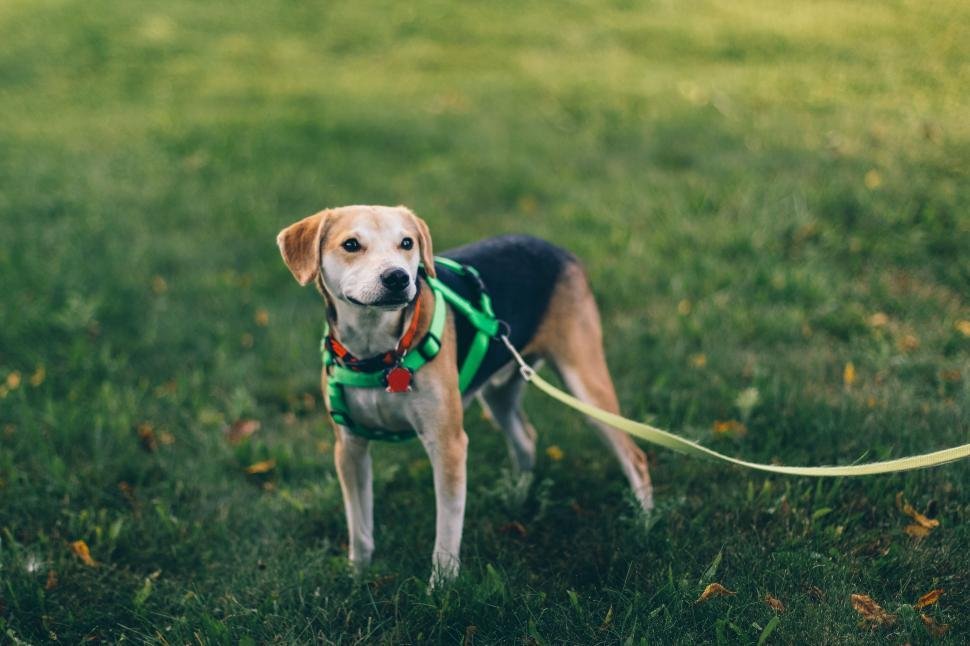
My neighbor has a three year old Rottweiler named Tank. The name is accurate. Last spring he went through two harnesses in four months because neither one was built for a dog that weighs more than most adults and moves like he means it. The first one had a buckle that cracked clean in half. The second had stitching that separated along the chest panel after about six weeks. Both were sold as “heavy duty.” Neither actually was.
If you have a large dog, the material your harness is made from is not a minor detail. It is the whole decision.
Table of Contents
Why Material Matters More With Large Dogs
A harness on a small dog handles relatively light stress. The dog weighs twelve pounds, the pulls are manageable, and even average materials hold up fine for a long time. Scale that up to a dog that weighs seventy or ninety pounds and everything changes. The forces involved during a hard pull, a sudden lunge, or a dog that spooks and bolts are genuinely significant. Weak materials fail under that stress, and a dog harness for large dogs that fails at the wrong moment is not just an inconvenience, it is a real safety problem.
Beyond strength, large dogs also mean more friction, more sweat, more wear from just the sheer size of the contact area. Materials that work fine on smaller harnesses wear down faster when they’re handling a bigger animal every single day. Understanding what your harness is actually made from helps you figure out whether it will last or whether you’ll be replacing it in three months.
The Most Common Materials and What They’re Actually Good For
Nylon
Nylon is the most widely used material in a dog harness for large dogs and for good reason. It’s strong, relatively lightweight, and holds up well through regular washing. The key word is quality. Basic thin nylon webbing wears through at friction points faster than you’d expect, especially on a large dog that pulls consistently. What you want is thick, tightly woven nylon with reinforced stitching at every stress point. Run your fingers across the webbing. If it feels flimsy or the weave looks loose, it’s going to show wear quickly.
Good nylon harnesses also hold their shape after washing, which matters because a harness that stretches or distorts when wet will fit differently after every wash and fit is everything on a large dog.
Polyester
Polyester is similar to nylon in a lot of ways but handles moisture slightly better. It doesn’t absorb water as readily, which means it dries faster and resists mildew better in wet climates or for dogs that swim often. It’s a solid choice for a dog harness for large dogs used in outdoor or active settings. The tradeoff is that some polyester webbing is less abrasion resistant than high quality nylon, so look at how thick the straps are before you buy.
Neoprene Padding
The strap material is one part of the equation. What’s underneath the straps is the other part. Neoprene padding is the best lining material for large dogs because it’s soft against the skin, flexible enough to move with the dog, and holds up through real use without compressing flat after a few months. Large dogs need padding that actually stays functional because the pressure from their body weight against the harness straps is considerably more than what a smaller dog experiences.
Cheap foam padding feels fine in the store and breaks down fast in real life. Neoprene costs a bit more and lasts significantly longer. On a dog the size of a German Shepherd or a Mastiff, that difference in comfort matters every single day.
Metal Hardware Versus Plastic
This is where a lot of large dog harnesses fall short. Plastic buckles and D-rings look fine on the shelf and fail under serious load. For a dog harness for large dogs, metal hardware is not optional. Steel or aluminum buckles, metal D-rings for the leash attachment, and metal adjustment sliders are what actually hold up when a large dog hits the end of the leash at full speed.
Check the leash attachment ring specifically. On lesser harnesses it’s often a lightweight plastic clip. That’s the exact point where failure is most dangerous because it’s the connection between your dog and your control. Metal only.
What to Look for When You’re Buying
Walk through these points before you commit to anything.
Check strap width first. Wider straps distribute pressure better across a large dog’s body and resist wear longer than narrow ones. Look at every stitch line closely, especially around the chest panel and the leash attachment points. Double stitching at stress points is a sign the manufacturer actually thought about load bearing. Feel the padding and press it firmly. Quality padding springs back. Cheap padding stays compressed.
A well-built dog harness for large dogs made from the right materials should realistically last two to three years of regular use before you need to think about replacing it.
Final Thoughts
The material your harness is made from determines everything downstream, how long it lasts, how comfortable your dog is, and whether it holds when it actually needs to. Thick nylon or polyester webbing, neoprene padding, and metal hardware are the combination worth paying for. Get that right on a dog harness for large dogs and you won’t be back shopping for a replacement in four months like my neighbor was.
Apart from that, if you want to know more about Dog Walking Insurance: Safeguarding Your Services then visit our Pets category.