Last Updated on August 22, 2026 by Abdul Rehman
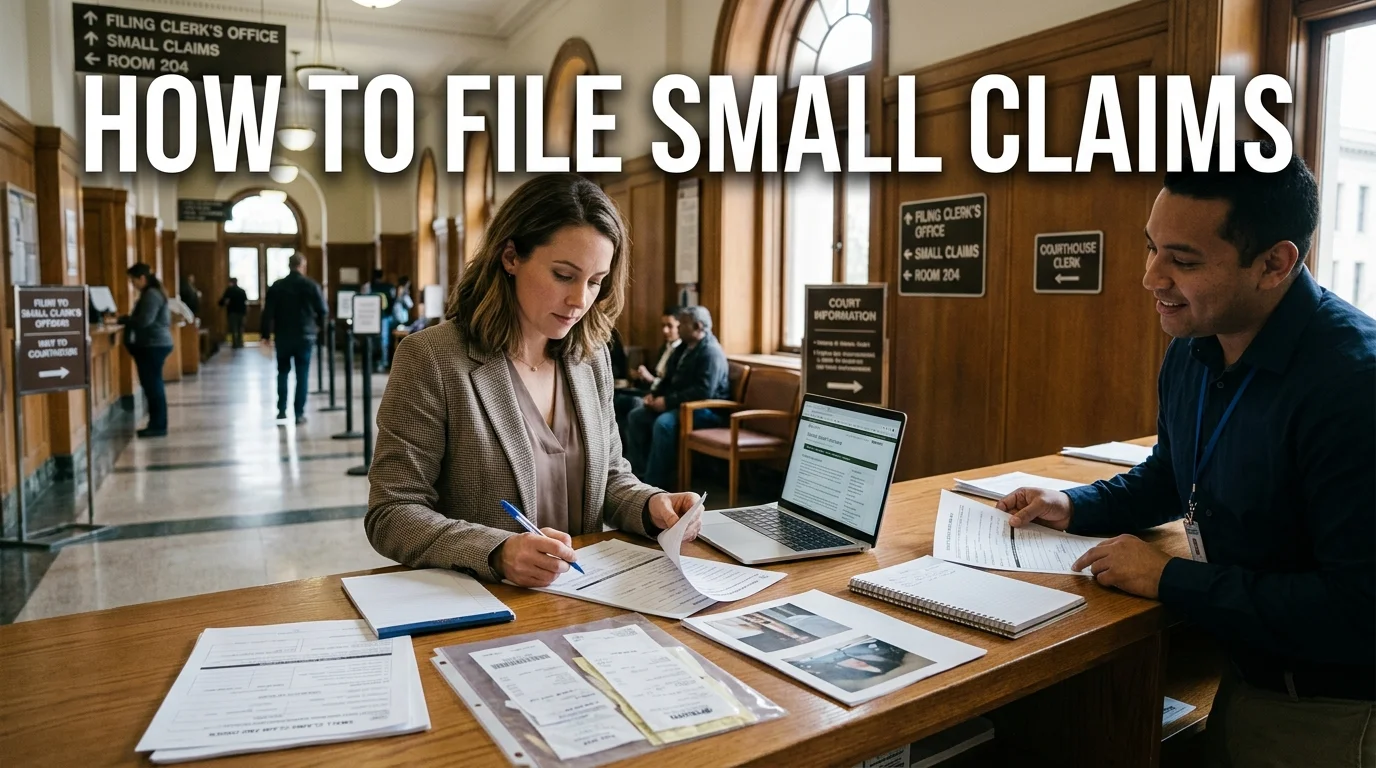
If you need to know how to file small claims, start by checking whether your dispute qualifies under your state’s rules. You’ll need the correct defendant, court location, claim amount, forms, and evidence. After filing, you usually must ensure that the defendant receives proper legal notice before the hearing.
Quick answer: To file a small claim, confirm that your dispute falls within your state’s monetary limit and filing deadline. Send a demand, choose the proper court, and complete the required claim form. Then pay the filing fee or request a waiver, serve the defendant correctly, and file proof of service. Bring organized evidence to the hearing.
| Key issue | What you usually need to do |
|---|---|
| Claim eligibility | Check the court’s dollar limit and allowed case types |
| Filing deadline | Confirm the statute of limitations for your dispute |
| Proper court | File in a court that has jurisdiction and proper venue |
| Defendant | Use the person’s or business’s correct legal name |
| Forms | Complete the court-approved complaint or claim form |
| Cost | Pay the filing fee or apply for a fee waiver if available |
| Notice | Follow your jurisdiction’s service-of-process rules |
| Hearing | Bring organized documents, witnesses, and a clear timeline |
| After judgment | Take collection steps if the losing party does not pay |
Small-claim limits can differ sharply between states. The California Courts’ self-help guide to small claims sets a $12,500 limit on many claims brought by individuals. Utah allows claims of up to $20,000, while Massachusetts generally uses a $7,000 limit. Always check the official court website for the court where you plan to file before relying on a specific dollar figure.
Table of Contents
What You’ll Need Before Filing
Gather the basic information before completing court forms. Having it ready can prevent delays and help you state your claim clearly.
You will usually need:
- Your full legal name and contact information.
- The defendant’s correct legal name and address.
- The exact amount you want the court to award.
- A short timeline of what happened.
- Contracts, invoices, receipts, photos, messages, or other supporting records.
- Information about earlier attempts to resolve the dispute.
- The filing fee or information needed to request a waiver.
If your dispute involves an accident, records and photographs can become especially important. Digestley also has guidance on collecting and preserving evidence after an accident.
How to File Small Claims in 8 Steps


1. Confirm That Your Case Qualifies
First, check whether the court can hear your type of dispute. These courts commonly handle money disputes involving unpaid debts, contracts, property damage, security deposits, or services that were not performed as promised. State rules can exclude certain claims or impose special requirements.
Check the maximum amount you can request. If your loss exceeds the limit, you may need to waive part of the claim or use another civil court. You should also check the statute of limitations. The deadline can depend on whether the case involves a written contract, an oral agreement, property damage, personal injury, or another legal theory.
2. Ask the Other Party to Resolve the Dispute
Try to settle the matter before filing. A written demand can state:
- What happened.
- What you believe the other party owes.
- The amount you are requesting.
- The basis for your request or the relevant agreement.
- A reasonable deadline for payment or another response.
Keep a copy and proof that you sent it. Some courts require a demand before a case begins. Even when it is optional, a clear written request creates useful documentation.
Rental disputes may involve additional rules. Digestley’s landlord-tenant legal guide provides additional background for disputes involving rental property.
3. Identify the Correct Defendant and Court
A strong claim can run into problems if you sue the wrong legal party.
For an individual, use the person’s full legal name. For a company, check its registered business name rather than relying only on a store name or brand.
Next, identify the proper filing location. Venue commonly depends on factors such as where the defendant lives, where a business operates, or where the dispute occurred.
Rules are not identical nationwide. Massachusetts, for example, allows filing based on specified connections between the parties and the court location. Other states use their own venue rules.
If you are unsure whether your dispute belongs in this court, Digestley’s guide to deciding when a lawsuit lawyer may be needed may help you identify situations that call for professional advice.
4. Calculate the Claim and Organize Your Evidence
Ask for an amount you can explain and support. For example, if a contractor took a $2,000 deposit and failed to perform the agreed-upon work, your evidence might include:
- The signed agreement.
- Proof of the $2,000 payment.
- Emails or messages about the work.
- Photos of unfinished work.
- Your written demand for repayment.
Prepare a simple calculation showing how you arrived at the amount you are requesting. Courts generally care more about clear proof than lengthy arguments. New York court guidance recommends organizing items such as agreements, letters, photographs, bills, receipts, and other documents before trial.
5. Complete the Required Court Forms
Get the current form from the official state or local court website. The form may be called a complaint, petition, plaintiff’s claim, or statement of claim. The names of these forms differ by jurisdiction.
You will normally enter:
- The parties’ names and addresses.
- The amount requested.
- A short explanation of the dispute.
- Relevant dates.
- Any required supporting information.
Review every name, address, and figure before submitting the form.
Some jurisdictions provide guided electronic filing. Massachusetts offers an online interview that prepares forms and allows eligible users to submit them electronically. Illinois also publishes standardized forms for these cases.
6. File the Case and Pay the Fee
Submit your completed documents using a method accepted by the court.
Depending on the jurisdiction, you may be able to file:
- Online.
- At the clerk’s office.
- By mail.
The clerk will usually assign a case number and provide information about the next stage of the process.
Filing costs differ by court and claim amount. If you cannot afford the required fee, check whether the court offers a fee waiver or reduced-fee application. Official court instructions in several states provide waiver procedures for qualifying filers.
Keep copies of everything you submit.
7. Serve the Defendant Correctly
Filing the complaint does not always complete your responsibilities.
The defendant must receive legal notice through an approved method called service of process. The permitted method depends on local rules.
Possible methods include service by:
- A sheriff or constable.
- A professional process server.
- An eligible adult who is not a party to the case.
- Court-arranged certified mail, where permitted.
Do not assume that you can hand the papers to the defendant yourself.
California instructions, for example, allow several service methods and impose deadlines tied to the hearing date. Illinois uses its own complaint and summons procedure.
Make sure that any required proof or return of service reaches the court on time.
8. Prepare for the Hearing and Judgment
Create a simple presentation of your case.
Arrange the facts in chronological order. Bring your supporting documents and enough copies if your court requires them. Be ready to explain what happened, what you lost, and why the defendant is responsible.
Avoid turning the hearing into a personal argument. Focus on dates, agreements, payments, damage, communications, and other evidence.
Digestley’s article on common mistakes people make when handling legal claims without an attorney also highlights the value of preserving evidence and meeting legal deadlines.
If the judge rules in your favor, the judgment does not always result in immediate payment. You may need to use enforcement procedures if the defendant does not pay voluntarily. Those procedures can include tools for identifying assets or pursuing court-authorized collection.
Common Filing Mistakes to Avoid
Several problems can delay a case or prevent a successful claim from moving forward.
Using the wrong defendant name: Confirm the legal identity of the person or company before filing.
Choosing the wrong court: Check jurisdiction and venue instead of simply selecting the nearest courthouse.
Missing the deadline: A claim filed after the applicable statute of limitations expires can face dismissal.
Requesting more than the court allows: Verify the current dollar limit before completing the form.
Serving papers incorrectly: Follow the court’s approved service method and deadline.
Showing up without organized evidence: Create a timeline and group supporting documents by issue.
Assuming a judgment guarantees payment: Winning establishes the obligation, but collection may require additional action.
For more related legal explainers, readers can browse Digestley’s Law section.
Do You Need a Lawyer?
These courts are intended to make lower-value civil disputes easier for individuals to handle, but rules about attorney participation differ by jurisdiction.
Consider speaking with a licensed attorney if your case involves complicated contracts, substantial injuries, several defendants, an out-of-state party, a government agency, or a claim that may exceed the local limit.
Professional advice can also help when you are unsure about jurisdiction, limitation periods, or which party you should sue.
Your Next Step
Before submitting anything, visit the official website for the court where you intend to file. Confirm the current monetary limit, deadline, filing form, fee, venue rule, service method, and hearing requirements.
Keep copies of every document and organize your evidence from the beginning. A few minutes spent checking local rules can prevent avoidable delays later.
This article provides general legal information for educational purposes. It is not legal advice and does not create an attorney-client relationship. Court rules, deadlines, fees, and claim limits can change. Confirm current requirements with your court or a licensed attorney.
Frequently Asked Questions
The court may consider entering a default judgment if the legal requirements have been met. You may still need to prove your claim and the amount of damages you are requesting.
Some jurisdictions allow online filing, while others require documents to be mailed or delivered to the clerk. Check your state judiciary or local court website for approved filing methods.
Fees vary by court and location. Some courts charge different amounts based on the size of the claim. Fee waivers may be available to people who qualify.