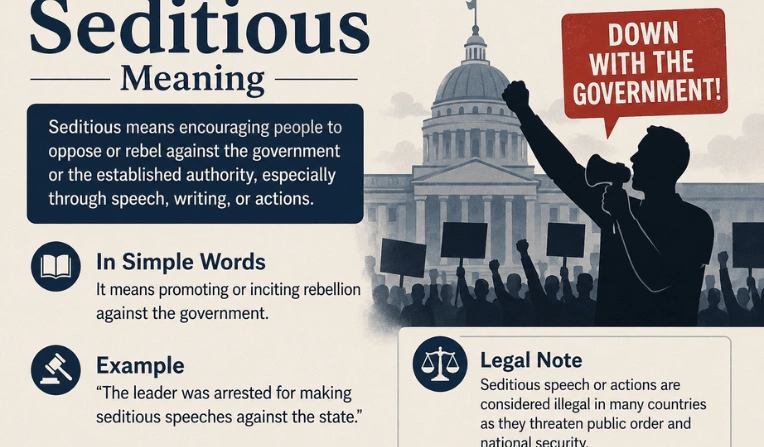
If you searched for the meaning of “seditious,” the word describes speech, writing, conduct, or people associated with encouraging resistance or rebellion against government authority. Seditious meaning: It usually appears in political, historical, or legal contexts. The term is stronger than words such as “critical,” “disloyal,” or “disagreeable.”
| Quick fact | Answer |
| Word | Seditious |
| Part of speech | Adjective |
| Pronunciation | si-DISH-us |
| Simple definition | Encouraging opposition or rebellion against government authority |
| Related noun | Sedition |
| Common contexts | Speech, writing, activity, material, conspiracy |
| Important distinction | Criticism of a government is not automatically sedition. |
Table of Contents
Seditious Meaning in Simple Terms

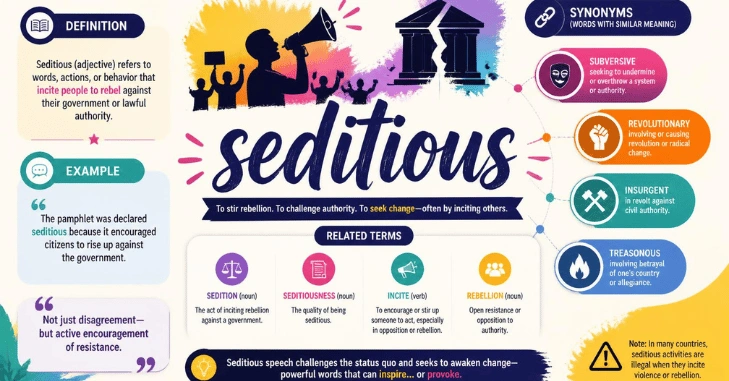
The easiest way to understand the adjective is to connect it with sedition.
“Sedition” refers to encouraging resistance, revolt, or insurrection against lawful authority. In plain English, the adjective usually means:
“Intended to stir people into opposing or rebelling against their government or established authority.”
The word often describes a speech, pamphlet, publication, organization, or form of conduct that encourages resistance to government authority.
Seditious Meaning: That makes the term more specific than a general word such as “controversial.” A controversial statement may cause arguments. A statement described as seditious carries the stronger suggestion that it encourages resistance or rebellion.
How Do You Pronounce the Word?
The common pronunciation is si-DISH-us.
The stress falls on the middle syllable: DISH.
You can break it into three parts:
- si
- DISH
- us
A useful memory trick is to connect the word with sedition. Once you know the noun, the adjective becomes easier to recognize and remember.
Examples in Sentences
Seeing the word in context makes its meaning and tone much clearer.
- The government accused the group of distributing seditious pamphlets.
- Officials claimed that the speech encouraged rebellion against state authority.
- The historian studied material that authorities had once labeled seditious.
- The novel describes a movement accused of encouraging resistance to the ruling government.
- The court had to consider the meaning and intent behind the disputed publication.
The first and third examples illustrate an important point. Describing something as seditious can reflect an accusation, interpretation, or official judgment. It does not, by itself, prove that a crime occurred.
Seditious meaning: Legal standards depend on the country, applicable law, facts, and historical period involved. A dictionary definition should not be treated as a complete legal test.
For a broader legal background, Digestley’s guide to legal services for non-lawyers explains several major areas of law.
Synonyms and Related Words: Seditious Meaning
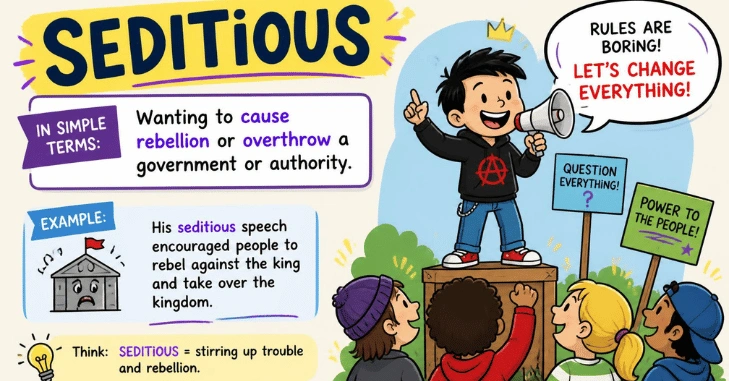
Several words overlap with this term, but they do not always mean the same thing.
| Related word | General sense | Best used when |
| Subversive | Seeking to weaken an established system | The focus is on undermining authority. |
| Rebellious | Resisting rules or authority | The context may be political or personal. |
| Insurgent | Connected with active revolt | Organized resistance is involved |
| Inflammatory | Likely to provoke strong reactions | The focus is on provoking conflict. |
| Mutinous | Resisting lawful command | Often used for soldiers, sailors, or organized groups |
| Revolutionary | Supporting major political change | The focus is on changing a political system. |
These words are related, but they are not perfect replacements for one another. Context determines which one fits best.
If the subject concerns criminal law, Digestley also has an explanation of criminal sentencing and its main forms.
Where Does the Word “Seditious” Come From?
The adjective has a long linguistic history.
It developed through Middle English and Old French from the Latin seditiosus, which comes from seditio. Its roots are associated with division, separation, resistance, and organized opposition to authority.
That origin fits the modern meaning well.
You do not need to know the Latin roots to use the word correctly. The useful connection is simple:
sedition = the noun
seditious = the adjective
Seditious vs. Sedition vs. Treason
These three terms are related, but they should not be used interchangeably.
| Term | Part of speech | Basic idea |
| Seditious | Adjective | Describes something associated with encouraging sedition |
| Sedition | Noun | Encouraging resistance or rebellion against lawful authority |
| Treason | Noun | Serious betrayal of one’s country, including certain acts against its government |
The practical distinction is straightforward: sedition centers on inciting or encouraging resistance, while treason centers more directly on betrayal or prohibited acts against one’s country.
Legal definitions can be narrower and may differ between jurisdictions. Use these explanations to understand the vocabulary, not to determine whether a real person has committed an offense.
Digestley readers who want more legal articles can also browse the site’s Law section.
Does Criticizing a Government Make Speech Seditious?

Not necessarily.
Ordinary criticism, protest, disagreement, satire, or support for political reform does not automatically fit the meaning of the word. The stronger idea is the encouragement of resistance, insurrection, or rebellion against established authority.
This distinction matters because the adjective carries a serious political and legal tone. Using it to describe every harsh criticism can exaggerate what a speaker or writer is doing.
When you encounter the term in news reports, historical writing, or political commentary, ask three questions:
- Who is applying the label?
- What action or speech is being described?
- Is the writer discussing ordinary criticism or the encouragement of rebellion?
Those questions help separate the word’s precise meaning from rhetorical or exaggerated use.
When Should You Use This Word?
Use the adjective when the context involves government authority, rebellion, organized resistance, or allegations of sedition.
Natural combinations include:
- seditious speech
- seditious writing
- seditious material
- seditious activity
- seditious publication
Avoid using the word as a dramatic substitute for “offensive,” “angry,” or “controversial.” Those words apply to much broader situations. It is also wise to use careful wording when discussing a real person. For example, “Authorities described the speech as seditious” is more precise than stating that a person committed a crime when that conclusion has not been legally established.
The Key Point to Remember

The simplest memory aid is to connect the adjective with sedition. If speech, writing, or conduct is described as seditious, the speaker usually means that it encourages serious resistance or rebellion against established government authority. It is a strong term, so context matters.
When you see the word in an article, court discussion, history book, or political debate, check who used the label and what conduct they were describing. That will give you a clearer understanding than treating the word as a general synonym for criticism.
Conclusion
The seditious meaning is best understood as relating to encouragement of serious resistance or rebellion against established government authority. It is a powerful word that should not be casually used as a synonym for “angry,” “offensive,” or “controversial.”
Learning the distinction between “seditious,” “sedition,” and “treason” can make legal, political, and historical writing much easier to understand. When encountering the term, always consider the context and remember that describing conduct as seditious does not by itself establish that a crime has been committed.
Frequently Asked Questions
It means encouraging, or tending to encourage, resistance, rebellion, or opposition against a government or lawful authority.
It is an adjective. The related noun is sedition.
“Subversive” or “rebellious” may fit in some contexts. “Inflammatory” and “incendiary” can also overlap when speech is intended to provoke conflict or action.
No. The words overlap in political contexts, but their meanings are not identical. Treason focuses more directly on betrayal of one’s country or on certain acts committed against it.
Yes. The adjective can describe speech, writing, acts, or publications that encourage opposition or rebellion against government authority.
Not necessarily. Its legal meaning and consequences depend on the law of the relevant jurisdiction and the facts involved. A dictionary definition alone cannot establish criminal responsibility.