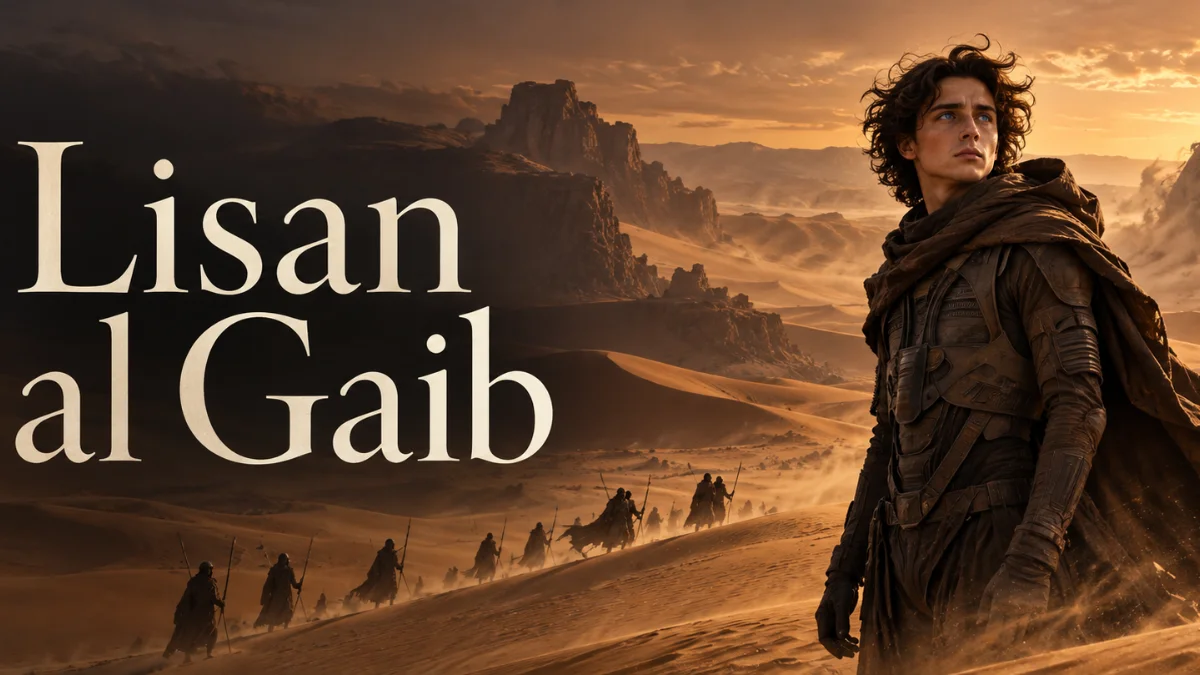
If you searched “lisan al gaib” after watching Dune, the phrase would describe the Fremen’s expected off-world prophet. Paul Atreides appears to fulfill that role as his influence grows across Arrakis. Yet Frank Herbert makes the prophecy far more complicated than a simple chosen-one story.
The Fremen understand Lisan al-Gaib as the “Voice from the Outer World.” Their traditions connect this figure with liberation, leadership, and a transformed future for Arrakis. The Bene Gesserit, however, deliberately helped establish the religious framework that makes Paul recognizable as that figure.
Direct answer: Lisan al-Gaib is the Fremen title for a prophesied outsider who will arrive on Arrakis and guide their people. In Dune, Paul Atreides becomes identified with that prophecy, although the Bene Gesserit deliberately planted its foundations generations before his arrival.
| Key fact | Explanation |
|---|---|
| Dune meaning | “Voice from the Outer World” |
| Who uses the title? | The Fremen of Arrakis |
| Who receives it? | Paul Atreides |
| Connected title | Mahdi |
| Prophecy’s origin | Bene Gesserit Missionaria Protectiva |
| Central theme | Faith, manipulation, power, and political myth |
| Arabic influence | *Lisān* relates to tongue or speech; *al-ghayb* refers to the unseen or hidden |
| First major appearance | Frank Herbert’s *Dune* |
Table of Contents
Key takeaways
- The title describes an expected prophet arriving from outside Arrakis.
- Paul fits enough signs that many Fremen accept him as their promised leader.
- The Bene Gesserit had planted useful religious ideas within Fremen culture.
- Paul possesses genuine abilities, making the manufactured prophecy unusually convincing.
- Herbert uses the story to question charismatic leaders and manufactured belief.
What Does Lisan al Gaib Mean in Dune?
Within Dune, the phrase means “Voice from the Outer World.” It identifies an outsider whom Fremen traditions expect to arrive on Arrakis. The original novel also associates the expression with the idea of a “Giver of Water.”
That wording matters because Paul arrives from Caladan rather than the desert planet. His unusual knowledge and Bene Gesserit training make his behavior appear prophetic to believers. His growing prescience strengthens that impression as the story progresses.
The phrase also carries linguistic influences beyond Herbert’s fictional universe. Harvard Divinity Bulletin notes that lisān can mean tongue or language. Al-ghayb describes what is hidden, unseen, absent, or unknown.
Is Paul Atreides Really the Lisan al-Gaib?
The answer depends on what “really” means within the story. Paul clearly fulfills many expectations that the Fremen associate with their promised outsider. He also becomes the political and military leader around whom their religious hopes gather. Yet the prophecy did not arise as an independent prediction of Paul’s future. The Bene Gesserit’s Missionaria Protectiva planted useful beliefs across the Imperium.
Those beliefs could protect Bene Gesserit members when they entered dangerous societies. That distinction creates one of Herbert’s central ironies. A manipulated prophecy becomes powerful because people sincerely believe it. Paul then possesses enough extraordinary abilities to make the manufactured story appear true.
Why Did the Bene Gesserit Create the Prophecy?
The Bene Gesserit plan across generations, cultures, and bloodlines. Their Missionaria Protectiva spreads religious ideas that trained Sisters can later recognize and exploit. Arrakis contains one of these cultural preparations. Jessica recognizes the signs soon after House Atreides arrives on the planet. In Denis Villeneuve’s first Dune film, she explains that the Fremen’s reaction shows Bene Gesserit involvement.
Paul quickly understands that people are seeing patterns they were trained to expect. The system gives Jessica and Paul an enormous survival advantage after House Atreides falls. They enter a society already prepared to interpret their characteristics religiously. Belief therefore becomes both protection and political power.
Readers interested in more film and television coverage can browse Digestley’s Entertainment section. The site also covers performers and screen careers across American popular culture.
Why Do the Fremen Believe Paul?
Paul arrives with several characteristics that appear to match existing expectations. He comes from another planet and travels with a Bene Gesserit mother. His training also gives him abilities that ordinary observers can easily interpret as supernatural. His knowledge becomes even more persuasive because his prescience isn’t entirely fraudulent. Paul experiences visions and eventually gains extraordinary awareness of possible futures.
Those abilities complicate any claim that he is merely pretending to be special. Stilgar becomes one of the strongest believers in Villeneuve’s adaptation. He repeatedly interprets Paul’s achievements as evidence supporting the prophecy. Chani provides a more skeptical viewpoint, especially in Dune: Part Two.
That contrast helps modern audiences see how confirmation bias works inside the story. Believers can turn almost any event into supporting evidence. Doubters see the same events while questioning the system that interprets them.
Lisan al-Gaib, Mahdi, and Kwisatz Haderach Are Different Titles
These three labels often appear together, but they describe different ideas. Confusing them can make Paul’s storyline seem more straightforward than Herbert intended. Each title comes from a different group and carries different expectations. Lisan al-Gaib describes the Fremen’s off-world prophetic figure. Mahdi concerns the leader expected to guide the Fremen toward paradise. The terms overlap within Fremen belief, but their emphasis differs.
Kwisatz Haderach belongs to the Bene Gesserit’s breeding program instead. It describes the powerful male figure the Sisterhood hoped to produce through controlled bloodlines. Paul therefore occupies several roles with different origins. This overlap is essential to his rise. Different groups can see the same person as fulfilling different plans. Paul eventually turns those expectations into a source of authority.
For more entertainment profiles, Digestley also covers actors such as Shane West and his film career. Its broader coverage includes changing careers across movies, television, and popular culture.
The Arabic and Persian Roots Behind the Phrase
Herbert drew heavily on Middle Eastern languages and religious concepts to build Fremen culture. The phrase resembles Arabic lisān al-ghayb. Literally, it refers to a tongue or voice connected to what is hidden or unseen. The expression also has a historical connection with the Persian poet Hafez. He became known by the honorific Lisān al-Ghayb, commonly rendered as “Tongue of the Unseen.”
In that historical context, the title does not correspond to Herbert’s fictional Fremen messiah. That difference deserves attention because fictional translations can obscure real linguistic history. Herbert adapted existing vocabulary for his imagined future rather than copying one tradition unchanged. Understanding that distinction makes the world-building richer and more accurate.
Why the Prophecy Matters to Dune’s Main Message
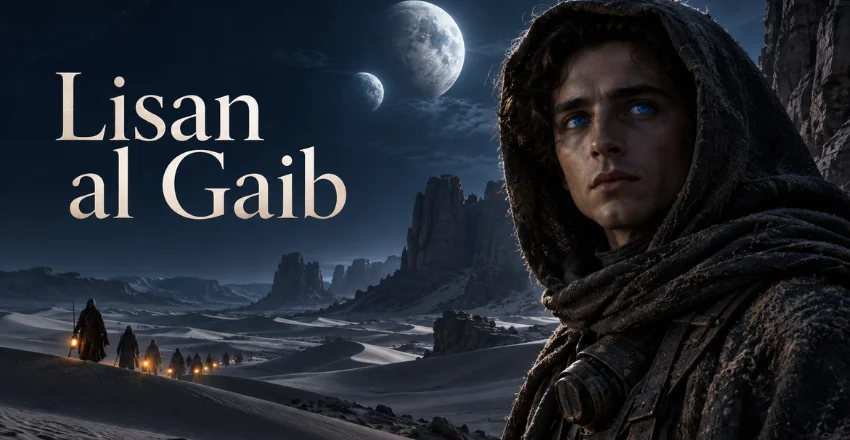
The prophecy is not simply a device that makes Paul look heroic. Herbert uses it to examine political charisma and collective belief. A population seeking freedom can become especially receptive to someone who seems to fulfill a promised destiny. Paul recognizes this danger before many people around him do. His visions show that victory may produce violence on an enormous scale. His ability to foresee danger does not guarantee he can prevent every consequence.
That tension separates Dune from a conventional savior story. Paul can possess remarkable powers while remaining a dangerous symbol. The story asks readers to examine why societies surrender judgment to charismatic leaders. This theme also explains why the Bene Gesserit’s manipulation matters so much. They did not need every invented detail to become literally true. They needed people to organize their perceptions around a useful story.
Digestley readers interested in entertainment personalities can also explore its Brian Austin Green profile. The site’s entertainment archive covers both current personalities and established screen history.
Why “Lisan al-Gaib” Became a Meme
The expression reached a much wider online audience after Denis Villeneuve’s Dune films. Javier Bardem’s intensely devoted Stilgar became especially important to the meme. Online jokes often portray him declaring ordinary achievements as proof of Paul’s prophetic status. The joke works because it exaggerates something already present in the film. Stilgar repeatedly reads Paul’s behavior through the prophecy he already believes.
That pattern gives viewers an easy template for joking about excessive admiration. The meme therefore carries more context than a simple movie catchphrase. It reflects one of the story’s central ideas: belief shapes interpretation. Someone who knows that background can understand both the joke and Herbert’s warning.
What the Title Ultimately Tells Us About Paul
Calling Paul the Fremen messiah is both understandable and incomplete. He becomes the figure people expected, but their expectation was deliberately engineered. His genuine abilities then give that engineered belief unprecedented force. That ambiguity is what makes his transformation compelling. Paul is neither a straightforward fraud nor a simple divine savior.
He is a gifted person entering a political system that is ready to turn him into something larger. Herbert therefore makes the title a warning as much as an honor. The crucial question is not whether Paul matches a checklist of signs. The deeper question concerns what happens when millions believe that one person embodies destiny.
Frequently Asked Questions
What does lisan al gaib mean?
In Dune, it means “Voice from the Outer World.” The title refers to an off-world prophet expected by the Fremen. Paul Atreides becomes associated with this role after arriving on Arrakis.
Is Lisan al-Gaib the same as Muad’Dib?
No, the names describe different aspects of Paul’s identity. Muad’Dib becomes Paul’s chosen Fremen name and later his public leadership identity. The prophetic title instead identifies him with an existing Fremen religious expectation.
Is the prophecy fake in Dune?
The Bene Gesserit deliberately planted its foundations rather than revealing it as an independent divine prediction. Still, Paul’s unusual abilities are genuine within the fictional setting. That combination makes “fake versus real” less useful than asking how the prophecy gains power.
Why does Stilgar believe Paul is the chosen one?
Stilgar interprets Paul’s background and achievements through religious expectations he already accepts. Paul’s skills, survival, knowledge, and eventual transformation reinforce that belief. The films use Stilgar’s certainty to show how existing faith changes the meaning of new evidence.
Is Lisan al-Gaib an actual Arabic phrase?
The fictional phrase draws on the Arabic lisān al-ghayb, a tongue or voice connected to the unseen. A related honorific was historically associated with Persian poet Hafez. Herbert adapted that language into a distinct fictional messianic idea.
The Takeaway
The Fremen prophecy gives Dune much more than another name for Paul Atreides. It connects religion, political manipulation, genuine supernatural ability, and the dangers surrounding charismatic leadership. Knowing its origins changes how Paul’s rise looks. What first appears to be a classic chosen-one storyline becomes something less comfortable.
People help create the leader they believe destiny promised them. That tension remains one of the strongest reasons Herbert’s story still invites debate decades later.