
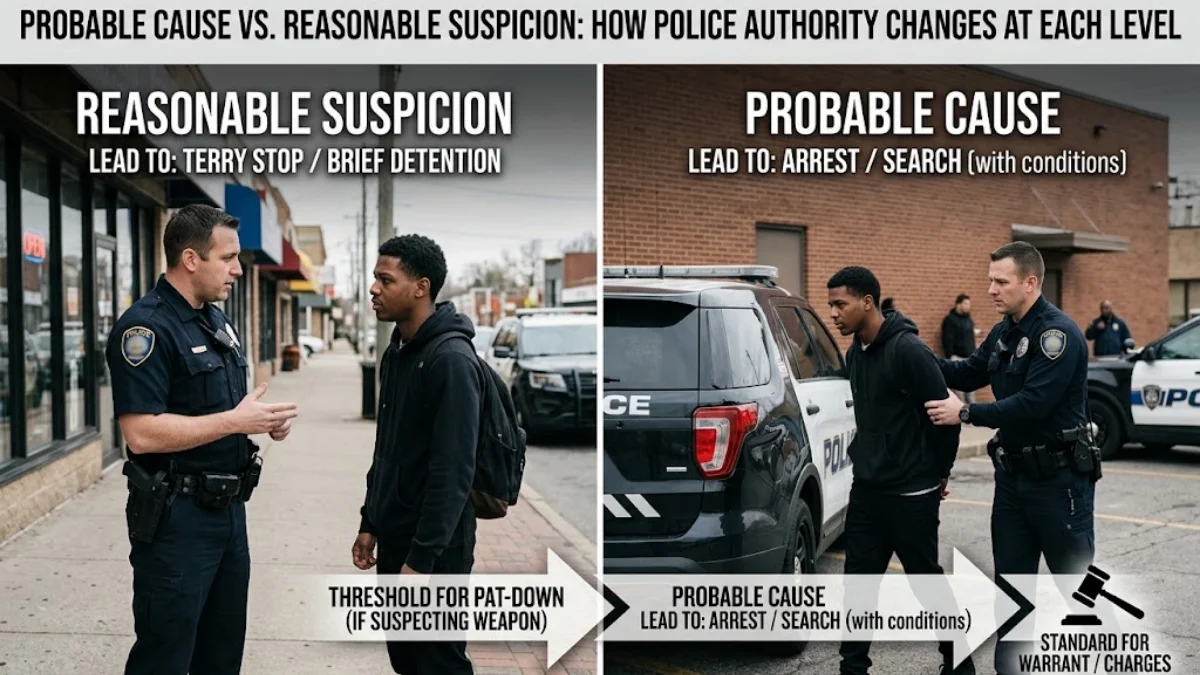
Understanding probable cause vs reasonable suspicion helps explain when U.S. police can stop, search, or arrest someone. Reasonable suspicion is the lower legal threshold and usually supports a brief investigative detention. Probable cause requires stronger facts and generally supports arrests, warrants, or certain searches.
Direct answer: Reasonable suspicion lets police briefly investigate when specific facts suggest possible criminal activity. Probable cause requires stronger evidence showing a fair probability that a crime occurred or evidence will be found. Neither standard uses a fixed percentage, because courts examine the circumstances surrounding each encounter.
| Key point | Reasonable suspicion | Probable cause |
|---|---|---|
| Legal threshold | Lower | Higher |
| Main purpose | Brief investigation | Arrest, warrant, or qualifying search |
| Evidence required | Specific, articulable facts | Facts showing a fair probability |
| Mere hunch enough? | No | No |
| Common example | Investigative traffic or pedestrian stop | Arrest based on developed evidence |
| Court approach | Totality of circumstances | Totality of circumstances |
Table of Contents
What Is Reasonable Suspicion?
Reasonable suspicion requires more than an officer’s instinct or unsupported hunch. The officer needs specific facts supporting an objective suspicion of criminal activity. Courts consider those facts together instead of demanding one decisive piece of evidence. The Supreme Court established the modern stop-and-frisk framework in Terry v. Ohio in 1968. The Court required specific and articulable facts supporting the police intrusion. It also required the officer’s actions to remain reasonably connected to the reason for the stop.
This standard can support a brief investigative stop involving a person or vehicle. An officer may ask questions while investigating the circumstances that justified the detention. The stop cannot automatically become an unlimited search or prolonged detention. A protective frisk has another important requirement. Police need reasonable grounds to believe the detained person may be armed and dangerous. The frisk is generally limited to finding weapons that could threaten safety. Digestley readers can see a related example in its article about drag racing charges and unlawful traffic stops. Traffic encounters often show why the justification for the initial stop matters. The facts available before the stop can determine whether later evidence faces a constitutional challenge.
What Is Probable Cause?
Probable cause is a stronger Fourth Amendment threshold than the standard required for a brief investigative stop. It exists when known circumstances support a reasonable belief concerning criminal conduct or evidence. The precise inquiry depends on whether authorities seek an arrest, search, or warrant. For an arrest, the facts generally must support a reasonable belief that the person committed a crime. For a search warrant, authorities generally need a fair probability that evidence exists in the specified place. Courts assess the available facts practically rather than demanding certainty.
The Supreme Court’s decision in Illinois v. Gates is especially important for warrant decisions. It rejected a rigid formula for evaluating information from informants. Instead, judges examine all relevant circumstances together when deciding whether sufficient grounds exist. The standard does not require proof beyond a reasonable doubt. That much higher burden applies when the government seeks a criminal conviction at trial. An arrest can therefore be lawful even when later evidence proves insufficient for conviction.
Probable Cause vs Reasonable Suspicion: The Main Difference
The central difference concerns how much objective justification police possess and what action that justification permits. A temporary investigative stop requires less support than taking someone into custody. More intrusive police actions generally demand greater constitutional justification. The Supreme Court has specifically described investigative suspicion as less demanding than the arrest threshold. It may involve information that would not establish the stronger standard. Still, officers must explain an objective basis instead of relying on intuition alone.
Another difference involves the scope of police authority. A lawful investigative detention must remain connected to its investigative purpose. A lawful arrest permits substantially greater control over the person’s freedom. These standards should not be converted into percentages. The Supreme Court has deliberately avoided creating a mathematical formula for either inquiry. Courts instead assess practical probabilities and the complete factual setting.
How Courts Decide Whether the Standard Was Met
Courts commonly examine the totality of the circumstances rather than evaluating each fact in isolation. A seemingly innocent fact may gain significance when combined with several other observations. Context can therefore change how the same conduct is legally evaluated. In United States v. Arvizu, the Supreme Court warned against separating every observation and dismissing each innocent explanation. Officers may draw reasonable inferences from their experience and training. Their conclusions still need an objective factual basis that a court can review.
For stronger Fourth Amendment justification, reliability also matters. Information from witnesses, informants, observations, and investigation can work together. Corroboration may strengthen information that would carry less weight by itself. Digestley’s Law section provides additional explanations of legal terminology and court-related topics. Its guide on evidence in legal claims also explains why documented facts matter. Different legal proceedings use different evidentiary standards, so the concepts should not be treated as interchangeable.
A Practical Example: A Stop That Develops Into an Arrest

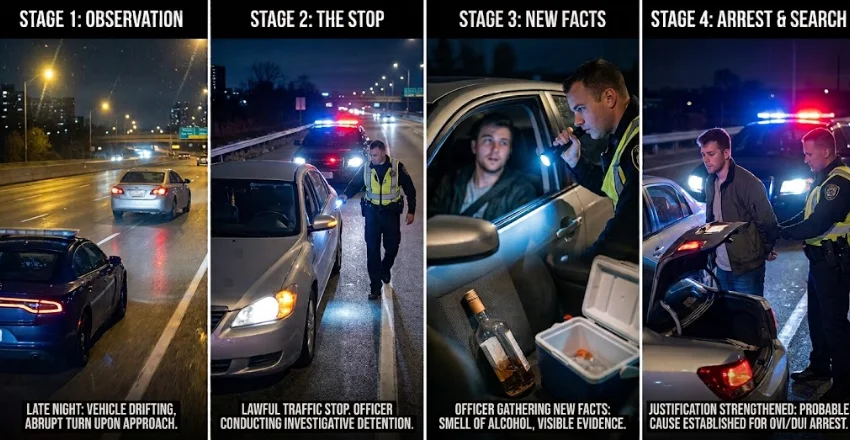
Imagine an officer sees a driver repeatedly drifting between lanes late at night. The officer also observes an abrupt turn after the patrol car approaches. Those combined observations could support further investigation depending on the complete circumstances. Suppose the officer then lawfully stops the vehicle and observes additional evidence suggesting a specific offense. New facts gathered during the lawful encounter can change the legal analysis. The justification available later may become stronger than the justification supporting the original stop.
The sequence matters because police authority can change as new facts develop. An investigative detention does not need to begin with enough information for an arrest. Likewise, an officer cannot assume stronger authority simply because a lawful temporary stop occurred. For another Digestley discussion involving traffic-law representation, see its guide to traffic violation lawyers. The article explains how lawyers may review officer observations and supporting evidence. Those records can become important when the legality of a stop is disputed.
Does Reasonable Suspicion Allow Police to Search You?
Not automatically. A valid investigative stop does not create unlimited authority to search a person’s belongings. The legal basis and permitted scope depend on what officers are trying to do. Terry permits a limited protective pat-down when officers reasonably believe a person is armed and dangerous. That safety search has a narrower purpose than an evidence search. It is not simply permission to inspect pockets, bags, or property for evidence.
Other Fourth Amendment rules may permit searches under different circumstances. Consent, warrants, certain arrest-related searches, and recognized exceptions involve separate legal questions. State constitutions and state laws can sometimes provide protections beyond the federal minimum.
Can Police Arrest Someone Based Only on Reasonable Suspicion?
The lower threshold generally supports detention rather than a traditional custodial arrest. Police ordinarily need the stronger constitutional basis before making a warrantless arrest. That distinction protects people from being arrested merely because their behavior seems unusual. A detention can still involve meaningful restrictions on movement. Someone briefly detained during an investigative stop is not necessarily free to leave. Yet the detention’s duration and scope remain important when courts review its reasonableness. A stop may also produce additional facts that support an arrest. The legal analysis then considers what the officers knew when the arrest occurred. Courts do not simply treat the initial suspicion as permanent authorization for every later action.
Can a Hunch Ever Be Enough?
A bare hunch does not satisfy the constitutional standard for an investigative stop. Terry required specific facts and rational inferences supporting the intrusion. Later Supreme Court decisions have continued using an objective, circumstance-based approach. Officers may rely on training and experience when interpreting conduct. That does not mean experience replaces factual support. Courts must still be able to identify the observations and circumstances behind the decision. This distinction matters because ordinary behavior can sometimes appear suspicious after the fact. Judicial review asks whether the available facts supported the action when it happened. Later discoveries cannot retroactively create justification that was missing at the relevant moment.
What Happens If Police Lack the Required Legal Basis?
An unconstitutional stop or search can affect whether evidence may be used in a criminal case. The exact consequence depends on the facts, applicable precedent, and available exceptions. Suppression issues can become complex and often require case-specific legal analysis. Not every police mistake automatically causes a case to disappear. Courts may examine several doctrines before deciding whether particular evidence is admissible. Federal and state rules can also differ in important ways. Someone facing a criminal charge should avoid relying solely on a general online explanation. A licensed attorney can evaluate the reports, recordings, warrant materials, and jurisdiction-specific law. Digestley’s guide to finding legal help for a lawsuit provides broader information about choosing legal representation.
The Key Point to Remember
The two standards reflect different levels of police authority under the Fourth Amendment. A brief investigation requires less justification than an arrest or warrant. Both standards remain objective and depend heavily on the facts known at the relevant time. If a real case involves a disputed stop, search, or arrest, small factual details can change the result. Video footage, officer reports, witness statements, and timing may all matter. Consider speaking with a qualified U.S. attorney for advice about a specific situation.
Frequently Asked Questions
What does probable cause vs reasonable suspicion mean in simple terms?
The first is the stronger threshold usually associated with arrests and warrants. The second can justify a limited investigation based on specific facts. Both require more than an unsupported police hunch.
Is probable cause the same as proof beyond a reasonable doubt?
No. Proof beyond a reasonable doubt is the much higher standard required for a criminal conviction. The threshold used for an arrest or warrant concerns probability rather than proof of guilt.
Can reasonable suspicion come from several small facts?
Yes. Courts examine the totality of the circumstances instead of requiring one dramatic fact. Several individually innocent observations can carry greater significance when considered together.
Does a traffic stop require probable cause?
Not necessarily. The Supreme Court recognizes that brief vehicle stops can fall under Fourth Amendment standards below the arrest threshold. The required justification depends on the reason and circumstances surrounding the stop.
Can police frisk everyone they stop?
No. A lawful stop does not automatically authorize a protective frisk. Officers need a reasonable basis to believe the person may be armed and dangerous.