

Last Updated on September 9, 2026 by Nasir Hanif
If your dog covers your hands, face, feet, or arms with enthusiastic licks, you may wonder, “Why Does My Dog Lick Me So Much?” The answer is usually a mixture of affection, instinct, taste, communication, and behaviors your dog has learned because they get a reaction. Most licking is completely normal, but a sudden or obsessive increase can occasionally point to stress, discomfort, or a medical problem.
Table of Contents
Why Does My Dog Lick Me So Much? The Quick Answer
Dogs lick people for several reasons, including affection, attention, social communication, the appeal of interesting smells and tastes, grooming instincts, and self-soothing. Frequent licking can also become a learned habit because people respond to it. If licking suddenly increases, seems compulsive, or accompanies pain, itching, anxiety, or other changes, contact your veterinarian.
There is no single translation for every lick, which is why context matters more than the behavior alone. A relaxed dog licking your hand when you arrive home is communicating something very different from a tense dog repeatedly licking during an uncomfortable interaction. Looking at when the licking happens, what part of you your dog targets, and the rest of the dog’s body language usually gives you the best clue.
1. Your Dog May Be Showing Affection
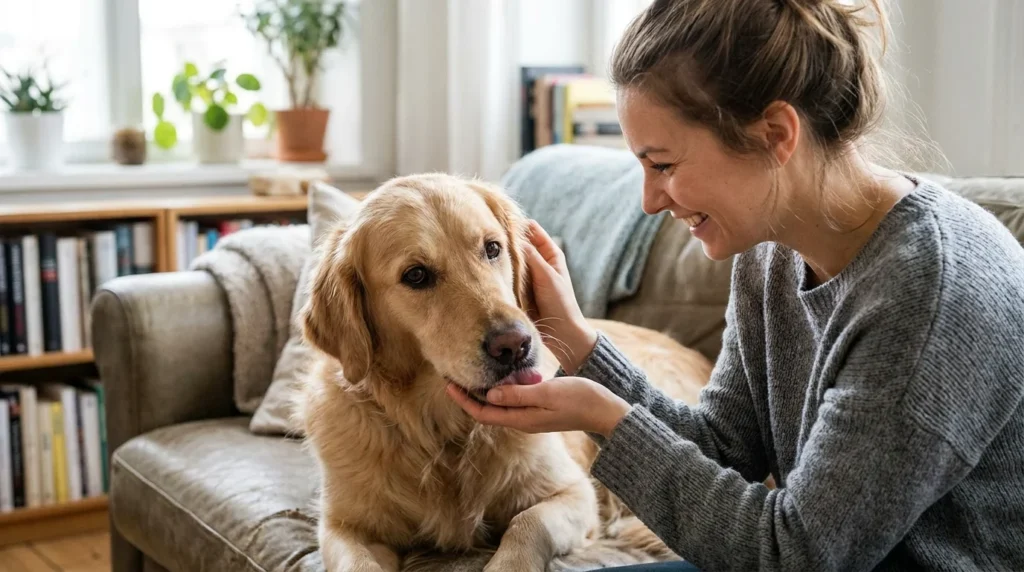
Affection is one of the most familiar explanations for licking, and in many cases it probably plays a role. Dogs use licking during social interactions, and the behavior can become associated with familiar people, comfort, attention, and bonding. Veterinary behavior resources also note that licking can be rewarding and calming for dogs, which helps explain why a relaxed dog may happily lick someone they trust.
That does not mean every lick is literally the canine equivalent of a human kiss. Dogs use the same behavior for several purposes, including communication, appeasement, exploration, and getting attention. It is more accurate to view affectionate licking as one possible part of a larger social interaction rather than a universal declaration of love.
2. Licking Gets Your Attention
Dogs are remarkably good at discovering which behaviors make humans respond. If licking makes you laugh, talk, pet your dog, make eye contact, or even tell your dog to stop, that reaction may reward the behavior from your dog’s perspective. Over time, a few casual licks can turn into a highly reliable strategy for getting your attention.
Even pushing your dog away can sometimes keep the pattern going because your dog still received interaction. This is why an attention-seeking licker may become especially persistent when you are working, watching television, talking on the phone, or focusing on someone else. If the behavior consistently produces a response, your dog has a reason to keep trying it.
3. You Taste and Smell Interesting
Sometimes the explanation is considerably less sentimental: your skin tastes good to your dog. Human skin carries sweat, salt, natural oils, food residue, lotions, and countless scents gathered throughout the day, giving a dog’s sensitive nose plenty to investigate. Hands and feet can be especially attractive because they carry strong, constantly changing smells.
A dog that suddenly becomes fascinated with you after exercise may be attracted to salty sweat. Your hands can also smell like whatever you recently cooked, ate, touched, or handled, whether indoors or outdoors. For a species that explores its surroundings through smell and taste, licking is another means of gathering information.
4. It Is Part of Normal Canine Social Communication
Licking begins early in a dog’s life and has several social functions. Mother dogs lick their puppies, puppies lick their mothers and littermates, and dogs continue using licking in social encounters as they mature. It can communicate friendliness, familiarity, appeasement, or a desire to interact.
This background helps explain why some dogs enthusiastically lick their owners when greeting them. Your arrival may trigger excitement and a burst of familiar social behaviors, especially if licking has always been part of your reunion routine. Watching the dog’s complete body language can help distinguish relaxed greeting behavior from licking driven by stress or uncertainty.
5. Your Dog May Be Grooming You
Dogs use licking as part of grooming themselves and interacting with other dogs. Some dogs appear to extend that behavior to people they are socially close to, particularly when everyone is relaxed together. The behavior may combine grooming instincts, familiarity, scent exploration, and social bonding rather than serving a single purpose.
You may notice this form of licking when your dog is settled beside you rather than highly excited. Slow, intermittent licking accompanied by loose posture and relaxed facial expressions is generally less concerning than frantic, repetitive licking that seems difficult for the dog to stop. As always, the surrounding context provides more information than licking by itself.
6. Licking Can Help a Dog Cope With Stress
Some dogs lick when they are anxious, uncertain, frustrated, or overstimulated. Repetitive licking can function as a self-soothing behavior, and veterinary sources note that dogs may lick people, themselves, or objects when coping with uncomfortable emotions. Stress-related behaviors need to be interpreted alongside thedog’ss posture, facial expression, environment, and recent events.
For example, consider whether the licking occurs during thunderstorms, arguments, visits, grooming, unfamiliar situations, or changes to your normal schedule. Other stress signals might include avoiding eye contact, turning away, tucked posture, panting when it is not hot, pacing, or difficulty settling. Persistent stress-related licking warrants attention because simply stopping the licking does not address the underlying cause of the dog’s discomfort
7. Your Dog Could Be Bored or Understimulated
A dog without enough appropriate activity may create activities of their own, and repetitive licking can become one of them. Physical exercise, sniffing opportunities, play, training, food puzzles, and predictable social interaction all give dogs healthier ways to use their energy. Veterinary behavior guidance commonly recommends enrichment and alternative activities when boredom appears to contribute to repetitive licking.
The goal is not simply to exhaust your dog with more exercise; mental stimulation matters, too. Short training sessions, sniff-heavy walks, puzzle feeders, safe chew activities, and opportunities to settle comfortably can make the day more satisfying. Digestley’s pet-friendly home guide also offers ideas for creating dedicated spaces for pets’ rest and activity.
8. You May Have Accidentally Turned Licking Into a Routine
Dogs notice patterns with impressive speed, especially when a behavior produces something valuable. If your dog licks you before breakfast and you immediately fill the food bowl, or licks your arm before you start a game, those sequences can become predictable routines. The licking may have started for one reason but continued because experience taught your dog what usually happens next.
Changing this pattern requires consistency rather than punishment. You can wait for a calm alternative behavior, such as sitting or settling on a mat, before providing the attention, game, or other reward your dog wants. Reinforcing the behavior you prefer gives your dog a clearer way to succeed than repeatedly saying “no” without showing them what to do instead.
9. Excessive Licking Can Signal a Behavioral or Medical Problem
Normal licking comes and goes, but excessive licking deserves a closer look when it becomes difficult to interrupt or interferes with ordinary activities. Anxiety and compulsive behavior can contribute, while dogs that repeatedly lick themselves may also be responding to allergies, skin irritation, infection, pain, parasites, or other medical problems. Merck Veterinary Manual describes compulsive behaviors as repetitive actions, including incessant licking, that occur much more frequently or for much longer than normal.
A sudden change is particularly worth noticing. If a dog that rarely licked you suddenly becomes intensely repetitive, consider what else has changed in the dog’s health, appetite, activity, environment, or behavior. Veterinary evaluation is the safest next step when the cause is unclear, or other symptoms appear.
What Different Types of Licking May Mean
Where and when your dog licks you can provide useful clues, although no location has one guaranteed meaning. Use this table as a starting point and combine it with your dog’s body language and the situation at hand.
| What your dog licks | Common explanations |
|---|---|
| Your hands | Food smells, salt, attention, greeting, or affection |
| Your feet | Strong scent, sweat and salt, curiosity, or learned attention-seeking |
| Your face | Social greeting, familiarity, food smells, attention, or appeasement |
| Your ears | Interesting scent, grooming-like behavior, or social interaction |
| Your arms or legs | Sweat, skin products, affection, attention, or routine |
| You during stressful situations | Possible self-soothing, uncertainty, or displacement behavior |
| You constantly and compulsively | Possible learned behavior, anxiety, discomfort, or another issue needing evaluation |
Why Does My Dog Lick My Face So Much?
Faces offer dogs a concentrated collection of interesting scents, tastes, and opportunities for interaction. Sweat, skin oils, traces of food, and the fact that humans react immediately to face licking can all reinforce the behavior. Dogs also use face and muzzle licking in social interactions, so the behavior can combine instinct, communication, curiosity, and learned attention-seeking.
However, face licking is one area where basic hygiene matters. The U.S. Centers for Disease Control and Prevention says dogs can carry germs even when they appear healthy, and current CDC guidance advises against allowing dogs to lick around the mouth and face or on open wounds. This is especially important around young children and people who may be more vulnerable to infections.
Why Does My Dog Lick My Hands So Much?
Hands constantly collect smells that fascinate dogs, as they touch food, household items, other people, and the outdoors. Licking your hands can therefore be simple investigation, particularly after you have cooked, eaten, or returned home. If you usually pet your dog immediately afterward, attention can become an additional reward that strengthens the habit.
Try paying attention to the timing for several days. If the licking peaks after meals, it may be scent- and taste-driven, while licking that reliably occurs when you stop petting your dog points more strongly toward attention-seeking. Recognizing the trigger makes it much easier to decide whether anything needs to change.
Why Does My Dog Lick My Feet So Much?
Feet combine sweat, salt, strong personal scent, and plenty of environmental odors, making them unusually interesting to many dogs. AKC notes that dogs lick to explore their surroundings and that owners’ immediate reactions can turn foot licking into an attention-seeking habit. A dog that gets laughter, movement, conversation, or play every time it targets your toes may quickly learn to repeat the experiment.
If you do not mind occasional licking, there may be nothing you need to change. If it becomes annoying, calmly remove access and reward your dog for choosing another activity rather than turning the moment into a game. Consistent responses matter much more than dramatic ones.
How Much Dog Licking Is Too Much?
There is no universal number of daily licks that separates normal from excessive behavior. What matters more is whether the behavior has changed, whether your dog can stop and move on, and whether licking is interfering with sleeping, playing, eating, walking, or normal interaction. Repetitive licking that causes skin irritation or seems driven rather than voluntary is much more concerning than a brief greeting after you come home.
Watch for warning signs like these.
- Licking that suddenly becomes much more frequent.
- Long licking sessions that are difficult to interrupt.
- Repeated licking accompanied by pacing, trembling, hiding, or other anxiety signs.
- Obsessive licking of the dog’s paws, legs, abdomen, or another body part.
- Redness, sores, hair loss, swelling, odor, or discharge.
- Limping or other indications of pain.
- Vomiting, diarrhea, appetite changes, or unusual lethargy.
- Licking that prevents the dog from resting or participating in normal activities.
- A major behavior change without an obvious explanation.
These signs do not automatically mean your dog has a serious condition. They do mean the licking should be considered as part of your dog’s overall health rather than treated as an isolated bad habit. A veterinarian can examine the dog and help separate medical causes from behavioral ones.
How to Stop Your Dog From Licking You So Much
If your veterinarian has ruled out health problems and you want less licking, focus on changing what happens before and after the behavior. Dogs learn through consequences, so repeated calm responses are usually more useful than punishment. VCA and AKC both recommend redirecting licking toward appropriate activities and reinforcing alternative behaviors.
Try this approach:
- Identify the trigger. Note when, where, and immediately before the licking usually happens.
- Avoid rewarding unwanted licking. If attention is the reward, quietly pause interaction rather than laughing, talking, or turning it into play.
- Teach an alternative. Ask for a sit, settle, touch, or go-to-mat behavior and reward that instead.
- Redirect appropriately. Offer a safe chew, a food puzzle, a toy, a sniffing activity, or another suitable outlet.
- Increase useful enrichment. Add age-appropriate exercise, sniff walks, play, short training sessions, and opportunities for calm rest.
- Be consistent. Everyone in the household should respond in roughly the same way so the dog receives a clear message.
Regular walks can also provide physical exercise, opportunities to sniff, and structured time with you. For owners of bigger breeds, Digestley’s guide to large-dog harness materials explains what to consider when choosing durable walking equipment. The purpose of these activities is not to punish licking but to give the dog predictable alternatives that are more rewarding.
Should You Punish a Dog for Licking?
Punishment is generally unnecessary for ordinary licking and can be counterproductive if the behavior is related to anxiety or uncertainty. Yelling, physical corrections, or frightening the dog does not teach a useful alternative and may add stress to an already uncomfortable situation. Positive reinforcement provides a clearer route by rewarding a behavior that cannot occur simultaneously with licking, such as resting on a mat or engaging with a toy.
It is also reasonable to have standards even if your dog is affectionate. You are not required to accept licking simply because the behavior is normal for dogs. Calmly ending the interaction and rewarding a different behavior helps you maintain that boundary without making the dog afraid to interact with you.
Is It Safe to Let Your Dog Lick You?
For most healthy people, casual contact with a healthy household dog is unlikely to create a serious problem, but dog mouths are not germ-free. CDC states that dogs can carry germs that make people sick and recommends washing hands after contact with dog saliva. The agency also advises keeping dog saliva away from open wounds and avoiding licking around the mouth and face.
The risk deserves extra consideration for people with weakened immune systems and for young children. CDC notes that bacteria commonly found in dogs’ mouths, including Capnocytophaga, can rarely cause serious infection when saliva enters an open wound or sore. Good hygiene, routine veterinary care, and keeping licking away from broken skin offer simple ways to reduce unnecessary exposure.
When Should You Call Your Veterinarian?
Contact your veterinarian when licking is sudden, intense, compulsive, associated with physical symptoms, or significantly different from your dog’s usual behavior. Medical causes are especially important to rule out when your dog is repeatedly licking their body, as allergies, infections, pain, gastrointestinal problems, and other conditions can contribute to abnormal licking. A veterinarian can perform an examination and determine whether behavioral support should be provided after medical issues have been ruled out.
You should also seek professional help if the behavior appears strongly connected to fear or anxiety. A qualified veterinarian, veterinary behaviorist, or appropriately credentialed behavior professional can help identify triggers and develop a humane management plan. Persistent problems are much easier to address when you understand the reason for the behavior rather than concentrating only on stopping the visible symptom.
Why does my dog suddenly lick me much more than usual?
A sudden change can result from changes in routine, stress, reinforcement, interesting new scents, or a shift in your dog’s physical condition. Because sudden behavioral changes sometimes accompany pain, anxiety, illness, or other discomfort, monitor for additional symptoms instead of assuming the new behavior is simply affection. Contact your veterinarian if the increase is persistent, difficult to interrupt, or accompanied by other changes.
Can I train my dog not to lick people?
Yes, many dogs can learn to greet and interact without licking. The most effective approach is usually to avoid rewarding unwanted licking while consistently rewarding another behavior such as sitting, touching a hand on cue, fetching a toy, or settling on a mat. Practice when your dog is calm so the alternative becomes familiar before you need it during an excited greeting.
Frequently Asked Questions
Do dogs lick you because they love you?
Affection can certainly be one reason your dog licks you, particularly during relaxed greetings or social interactions. However, licking can also mean your dog wants attention, likes the taste of your skin, is exploring your scent, or is trying to soothe themselves. The rest of your dog’s body language and the situation tell you more than the lick alone.
Why does my dog lick me nonstop when I pet them?
Your dog may associate petting with social grooming, affection, excitement, or reciprocal attention. If you continue petting whenever licking starts, your response may reinforce the behavior and make it more likely to occur again. If the licking seems frantic rather than relaxed, observe the rest of your dog’s body language to make sure the interaction is comfortable for them.
Why does my dog lick me more than anyone else?
You may provide the most rewarding reaction, have a scent your dog particularly likes, or be the person with whom the dog has developed the strongest licking routine. Dogs can learn very specific habits around individual family members because each person responds differently. Being the favorite licking target therefore does not necessarily mean your dog loves everyone else less.
Why does my dog lick me before sleeping?
Bedtime licking may occur because your dog is relaxed, engaging in a familiar bonding routine, or using repetitive licking to settle themselves. If the behavior is brief and your dog then falls asleep comfortably, it is usually less concerning than prolonged, frantic licking. A new pattern of restless nighttime licking, combined with pacing, discomfort, or inability to sleep, warrants closer attention.