


If you want to buy foreclosed homes, start by choosing the right purchase stage. Bank-owned properties usually offer easier financing and access to inspections than courthouse auctions. Auctions can offer opportunities, but they often carry more title, condition, and payment risk.
Foreclosure activity also remains relevant for U.S. buyers in 2026. ATTOM reported roughly 40,000 properties with foreclosure filings during August 2026. That total was higher than it was a year earlier.
Table of Contents
Foreclosure Home Buying at a Glance
| Buying method | Financing | Inspection access | Main risk | Best suited for |
|---|---|---|---|---|
| Pre-foreclosure | Usually available | Often available | Seller and lender approvals | Patient buyers |
| Foreclosure auction | Often cash or fast funds | Frequently limited | Title, occupancy, property condition | Experienced buyers |
| Bank-owned REO | Conventional financing often possible | Usually available | Repairs and slower approval | Most homebuyers |
| HUD home | Financing may be available | Depends on property | Property condition and bid rules | Owner-occupants and qualified buyers |
| Fannie Mae HomePath | Financing may be available | Usually available | Competition and property condition | Owner-occupants and investors |
| Freddie Mac HomeSteps | Financing may be available | Usually available | Competition after priority period | Owner-occupants and investors |
Direct answer: To buy a foreclosure property, set your budget, secure financing, and choose between pre-foreclosure, auction, or REO listings. Then research the property, investigate its title, inspect it whenever possible, estimate repairs, and submit an offer or bid. Never assume a low asking price automatically means a bargain.
What Is a Foreclosure Property?
A foreclosure occurs after a borrower defaults and the lender uses a legal process to recover the property. The exact procedure differs among states. A property may pass through several stages before the lender finally takes ownership.
An REO, or real estate-owned property, has already returned to the lender after foreclosure. This stage often more closely resembles a conventional purchase. Bank of America notes that REO purchases commonly involve agents, inspections, financing, and lender approval.
Buyers should also understand that a foreclosure listing does not guarantee a below-market price. Freddie Mac says it markets its HomeSteps properties based on local values and property condition. Successful offers often stay close to comparable neighborhood values.
What You’ll Need Before You Start
Prepare your finances before searching seriously. You may need a mortgage preapproval, proof of cash reserves, and money for repairs. Auction buyers can face stricter funding deadlines than ordinary homebuyers.
You should also identify professionals who understand distressed real estate. An experienced agent can explain local listing and offer procedures. A real estate attorney or title professional can help identify legal problems before closing.
Digestley has additional guidance on choosing a real estate lawyer and understanding real estate purchase contracts. Those topics become especially important when a property has liens, unusual clauses, or complicated ownership records. Review legal documents before committing nonrefundable money.
How to Buy Foreclosed Homes in 7 Steps
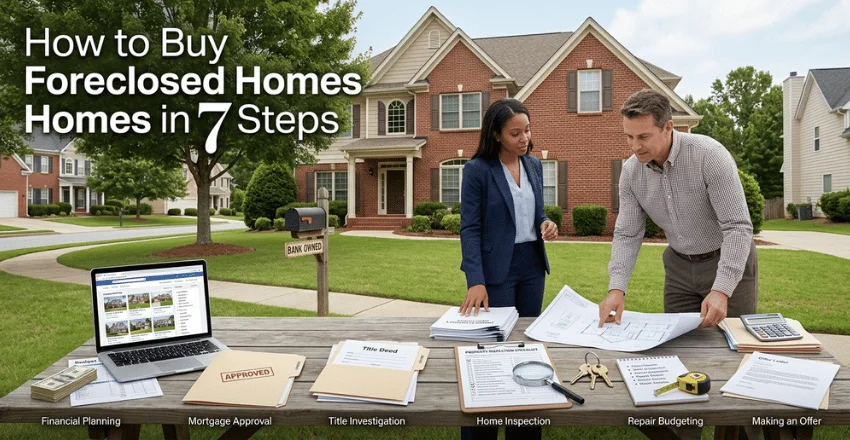
1. Set a Complete Purchase Budget
Start with the maximum amount you can safely spend. Include the purchase price, closing costs, repairs, taxes, insurance, and immediate maintenance. A cheap property can become expensive after neglected repairs appear.
Leave a repair reserve instead of spending your entire budget on the winning price. Vacant properties may have plumbing, roofing, electrical, or moisture problems. An unknown maintenance history makes a financial cushion even more valuable.
Property taxes also affect your ownership costs after closing. Digestley’s guide to reducing annual property taxes explains how assessments can influence ongoing expenses. Research the current assessment and any unpaid taxes before buying.
2. Get Preapproved or Prepare Verified Funds
Obtain mortgage preapproval before pursuing an REO listing. Sellers can favor buyers who show they have financing arranged. Preapproval also gives you a clearer offer ceiling.
Cash buyers should prepare acceptable proof of funds. Auction rules can require certified funds or fast payment after a winning bid. Never assume you can arrange a standard mortgage after winning.
Freddie Mac’s HomeSteps program requires a preapproval letter with financed offers. Cash offers require proof of funds instead. Its offer process also calls for certified earnest money after contract execution.
3. Choose the Foreclosure Stage That Fits You
Pre-foreclosure purchases happen before the lender completes the foreclosure. You may negotiate with the owner, although lender involvement can complicate some transactions. Inspection access can be better than at an auction.
Public auctions usually carry the greatest uncertainty. Buyers might receive limited access to the interior before bidding. They may also face short payment deadlines and occupancy problems after purchase.
REO properties are generally simpler for ordinary buyers. A lender already owns the property and can list it through an agent. Financing and inspections are more likely to resemble a standard sale.
4. Find Legitimate Listings
Start with the local MLS and major property portals. Real estate agents can search specifically for REOs and distressed listings. County websites may publish foreclosure auction notices and related public records.
Federal and government-sponsored programs provide additional sources. Fannie Mae lists its own properties through HomePath. Freddie Mac sells its REO inventory through HomeSteps.
HUD also sells properties acquired after foreclosures involving FHA-insured mortgages. HUD states that any broker properly registered with HUD may submit purchase contracts for buyers. Many HUD properties receive an initial owner-occupant priority period.
You can also browse Digestley’s broader real estate resources for related homebuying topics. Always verify a listing against official records before sending deposits. Fraudsters can copy legitimate property details into fake advertisements.
5. Investigate the Title, Occupancy, and Property
Check ownership records before committing serious money. Search for recorded liens, unpaid taxes, judgments, easements, or competing ownership claims. A title company or attorney can perform a professional title examination.
Occupancy matters too. A property may still contain former owners or lawful tenants. Federal and state protections can affect how and when occupants must leave.
Freddie Mac notes that some tenants in its acquired properties may remain under qualifying leases. State law can provide additional protections. Never assume winning an auction gives immediate physical possession.
6. Inspect the Home and Price the Repairs
Get a professional inspection whenever the sale allows one. A normal-looking house can hide expensive structural, electrical, roofing, or water problems. Many institutional sellers transfer these properties as-is.
Separate urgent repairs from optional improvements. Obtain estimates for major work before finalizing your offer. Then combine those estimates with your purchase and closing costs.
Suppose a property costs $220,000 and needs $45,000 in essential work. Your practical investment already reaches $265,000 before many transaction expenses. Compare that figure with repaired comparable homes before calling the purchase a bargain.
7. Make a Disciplined Offer or Auction Bid
Base your offer on comparable sales and the property’s condition. Subtract realistic repair costs and account for your required financial cushion. Don’t bid higher just because competition gets emotional.
REO sellers can counter, reject, or request revised terms. Freddie Mac says complete HomeSteps offers are often answered or countered within 48 hours. Final approval can still take longer.
Auction buyers should set a hard maximum before bidding begins. Include possible buyer premiums, title costs, repairs, and carrying expenses in that number. A winning bid above your safe limit is not a victory.
Where U.S. Buyers Can Find Government-Owned Properties
Fannie Mae’s HomePath portal provides searchable listings for Fannie Mae-owned properties. Its First Look program gives eligible owner-occupants and certain community buyers early access. The current First Look period lasts 30 days.
Freddie Mac provides a similar program through HomeSteps. Eligible owner-occupants can submit offers during the first 30 listing days without investor competition. Buyers do not have to be first-time homeowners.
HUD Home Store is another official source for government-owned homes. HUD properties come from defaults on FHA-insured mortgages. Buyers generally work through registered real estate brokers when submitting bids.
Biggest Risks Buyers Should Check
The first major risk is property condition. A vacant house may have deferred maintenance or damage that a lender never observed. Limited inspection access makes that uncertainty greater at auctions.
The second risk involves title and possession. Existing liens, tax obligations, legal claims, or occupants can complicate the transaction. State foreclosure procedures can also affect redemption rights and transfer timing.
The third risk is overpaying for a supposed bargain. Distressed property prices must be compared with repair costs and local values. A lower sticker price does not guarantee usable equity.
Are Foreclosures Still Available in 2026?
Yes, foreclosure inventory continues to enter the U.S. market. ATTOM reported roughly 40,000 foreclosure filings nationwide during August 2026. Completed lender repossessions also rose compared with a year earlier.
Those numbers do not mean every area has abundant discounted inventory. Foreclosure levels vary sharply by state and city. Buyers should judge opportunities using local listings rather than national headlines.
Availability can also change from month to month. Set alerts on official portals and ask an agent to monitor the MLS. Fast notification can matter when a well-priced REO becomes available.
Frequently Asked Questions
Is it difficult to learn how to buy foreclosed homes?
The basic purchase process is understandable for most buyers. The difficult parts are researching the property, understanding local legal rules, and accurately pricing unknown repairs. REO purchases are usually easier for beginners than courthouse auctions.
A skilled agent can reduce procedural mistakes during an REO purchase. Title professionals and attorneys can help with ownership questions. Auction buyers should understand all local sale conditions before bidding.
Can you finance a foreclosure property?
Many REO purchases can use mortgage financing if the property meets lender requirements. Conventional and renovation financing may be possible depending on your qualifications. Severely damaged properties can be harder to finance.
Auction financing works differently. Some sales require cash or certified funds within a short period. Read the auction terms before assuming a mortgage will work.
Can you inspect one before buying?
REO listings commonly allow buyers to inspect the home before closing. Pre-foreclosure sellers may also permit inspections. Auction properties can offer much less access.
Never skip an available inspection because a property appears inexpensive. Inspection findings can change your repair estimate substantially. They can also show that walking away is the cheaper option.
Are foreclosure properties always cheaper?
No. Lenders may price an REO near its current market value. Freddie Mac specifically says many HomeSteps sales finish close to estimated market value.
The useful comparison is the total acquisition cost. Add repairs, fees, carrying expenses, and closing costs to your price. Compare that total with similar homes in ready-to-live condition.
Do foreclosure laws differ by state?
Yes, procedures and timelines vary substantially across the United States. Some states use judicial foreclosure, while others permit nonjudicial procedures. Redemption and possession rules can also differ.
Local rules matter most for auctions and occupied properties. Review your county’s sale terms and current state law before bidding, including any redemption period that may let the former owner reclaim the property after the sale. Seek local legal advice when a transaction presents unresolved ownership or occupancy issues.
Final Checklist Before You Buy
Before submitting money, confirm the property’s ownership and foreclosure stage. Verify your financing, title findings, repair estimate, and maximum purchase price. Review every sale condition and deadline.
Treat the advertised price as one part of the decision. Your true cost includes repairs, taxes, insurance, title work, fees, and financing expenses. Those numbers determine whether the deal makes financial sense.
For most first-time buyers, an REO listing offers the most manageable entry point. You usually get more time for financing and due diligence. Choose a property only after the numbers and legal details support the purchase. This guide is general information, not legal or financial advice, so consult a licensed attorney, lender, or advisor about your situation.