

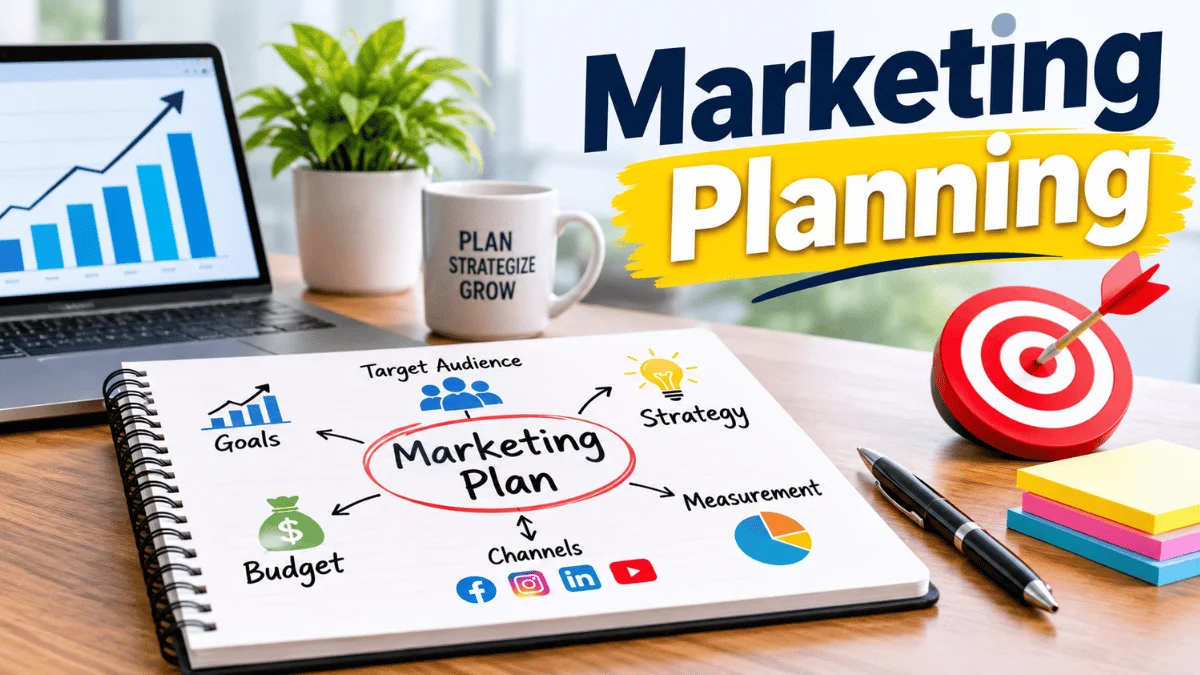
Marketing planning turns broad business goals into specific actions your team can execute and measure. It defines who you want to reach, what you want them to do, and how you will reach them. A useful plan also connects spending and daily marketing work to measurable business results.
Direct answer: Marketing planning is the process of analyzing your market, setting measurable goals, defining your audience, choosing strategies and channels, allocating resources, and tracking results. A strong plan gives your team clear priorities while creating a system for reviewing performance and changing direction when customer behavior or business conditions shift.
| Planning Area | Key Question | Typical Output |
|---|---|---|
| Business goals | What must marketing help achieve? | Revenue, leads, retention, or awareness targets |
| Market analysis | What is happening around the business? | Customer, competitor, and SWOT findings |
| Target audience | Who should the business reach? | Priority customer segments or personas |
| Positioning | Why should customers choose you? | Value proposition and core message |
| Channels | Where should the message appear? | Search, email, social, paid media, or partnerships |
| Budget | What resources are available? | Spending limits by activity |
| Measurement | How will success be judged? | KPIs, reporting schedule, and review dates |
Table of Contents
Key Takeaways
- Start with business goals before choosing marketing channels.
- Define a specific audience instead of trying to reach everyone.
- Connect each marketing activity to one measurable objective.
- Set a budget before campaigns begin.
- Assign clear ownership for every major action.
- Review performance regularly instead of waiting until year-end.
- Change tactics when evidence shows another approach will work better.
What Is Marketing Planning?
Marketing planning is a structured process for deciding what your marketing should accomplish and how you will accomplish it. The process usually covers research, goals, audience selection, strategy, resources, execution, and measurement. It creates a shared roadmap rather than a collection of disconnected campaigns.
The finished marketing plan is the document created through that process. It records the decisions your team has made and the actions people must take. Your planning process should remain active because markets and customer behavior rarely stay fixed.
This distinction matters for businesses that treat the annual plan as a fixed document. A useful plan gives direction without preventing sensible adjustments. Your strategy should remain stable enough to guide decisions while tactics respond to new information.
Why a Marketing Plan Matters
A written plan forces a business to decide what deserves attention first. Teams without clear priorities often spread budgets across too many channels. That approach can make performance difficult to evaluate and resources harder to control.
Planning also connects marketing decisions to wider business objectives. A campaign should support a defined outcome rather than exist because a platform looks popular. That outcome might involve qualified leads, new customers, retention, revenue, or stronger brand recognition.
Clear planning also improves accountability across a team. Each activity can have an owner, deadline, budget, and performance measure. Leaders can then identify what worked and make better spending decisions during the next planning cycle.
For businesses building awareness, Digestley’s Brand Awareness Marketing: What You Should Know provides additional ideas for strengthening recognition. Brand-building activities can support a wider plan when awareness is tied to a clear target audience. The channel should serve the objective, not become the objective itself.
Marketing Planning in 7 Practical Steps

The process does not need to become a large corporate exercise. Small businesses can use the same principles with fewer pages and simpler reporting. These seven steps provide enough structure for most U.S. organizations.
1. Connect Marketing to a Business Goal
Begin with the business result that marketing should support. Avoid goals such as “post more content” because they describe activity rather than impact. Choose an outcome that matters to the organization.
Your goal could involve increasing qualified leads, improving customer retention, or supporting a new product launch. Add a deadline and a measurable target. This creates a standard for evaluating every later decision.
A local service company might target 120 qualified inquiries during the next quarter. An ecommerce business might focus on increasing repeat purchases from existing customers. Different goals require different audiences, messages, and channels.
2. Analyze Your Current Position
Review what is happening inside the business and across its market. Look at recent performance, customer feedback, competitor activity, and major changes affecting demand. A simple SWOT analysis can help organize the findings.
Do not collect information without connecting it to a decision. Identify where demand is growing, which channels perform well, and where competitors appear stronger. Pay particular attention to evidence that challenges your existing assumptions.
Your historical marketing data should also shape the analysis. Compare traffic, leads, conversion rates, acquisition costs, and revenue where available. The purpose is to establish a realistic starting point.
3. Define the Audience You Need to Reach
A useful target audience is narrower than “people who might buy.” Define the customers most likely to need your offer and contribute to your goal. Consider their problems, priorities, buying triggers, and preferred information sources.
Demographics can help, but buying behavior often provides stronger guidance. Two customers of the same age may research and purchase in completely different ways. Focus on characteristics that influence the marketing decision.
You should also understand where each audience sits in the buying journey. New prospects may need education before considering your offer. Existing customers may respond better to email, loyalty programs, or relevant follow-up offers.
4. Decide Your Positioning and Message
Customers need a clear reason to pay attention to your business. Define the problem you solve, the value you provide, and what separates you from alternatives. Keep the message specific enough to guide future campaign decisions.
Your positioning should match what customers value, not what the company enjoys discussing. Product features matter when they produce a meaningful customer benefit. Translate those features into outcomes your audience can understand quickly.
Message consistency also supports stronger brand recognition over time. Advertising, search content, email, and social campaigns should not describe the business in conflicting ways. The format can change, but the central promise should remain recognizable.
5. Choose Channels Based on the Goal. Choose channels
Choose channels after you understand your audience and objective. Search, email, paid advertising, social media, partnerships, influencers, and offline media solve different problems. Using every available channel usually creates unnecessary complexity.
Search content can help when customers actively research problems or solutions. Email can support lead nurturing, repeat purchases, and customer retention. Paid media can provide faster reach when targeting and economics support the cost.
Digestley’s guide to influencer marketing can help when trusted creators fit your audience and offer. Its guide to 2026 SEO and generative engine optimization also explains changing search behavior. Both tactics work better when they support a broader strategy.
For example, a business might use search content to attract potential customers. It could then capture interested visitors through an email offer. Retargeting can support the same objective without turning three channels into three unrelated campaigns.
6. Set the Budget, Timeline, and Ownership
Every significant marketing action needs resources and an owner. Estimate spending for media, software, contractors, content, events, or production before execution begins. Include internal time because employee capacity is also a limited resource.
Then convert the strategy into a working calendar. Add campaign launches, content deadlines, review dates, and important seasonal periods. U.S. businesses may also plan around major retail periods or industry-specific buying cycles.
Assign one accountable owner to each major initiative. Several people can contribute, but ownership should never be unclear. A named owner makes deadlines and reporting much easier to manage.
7. Measure Results and Adjust the Plan
Choose performance indicators that match the original goal. Website traffic can be useful, but it does not automatically represent business growth. A lead-generation plan might track qualified inquiries, conversion rates, cost per lead, and resulting sales.
Create a simple reporting rhythm before campaigns launch. Weekly monitoring can flag technical issues or sudden performance shifts. Monthly and quarterly reviews can support larger budget or strategy decisions.
Do not change a plan because one metric moved for several days. Look for meaningful patterns and compare results with your targets. Change the tactic when evidence supports a better route to the same business objective.
A Simple Marketing Plan Example
Consider a U.S. home-services company that wants more profitable jobs during the next quarter. Its goal is to generate 150 qualified leads within a defined service area. The company decides that homeowners searching for urgent solutions represent its highest-priority audience.
The company uses local search content, paid search ads, and email follow-up for existing inquiries. It allocates most of the budget to channels that drive high-intent demand. Brand-focused social content receives a smaller supporting budget.
The team reviews lead quality and acquisition costs every month. If paid search produces expensive, low-quality inquiries, the team can adjust targeting or spend. The business goal remains stable while the tactical mix changes.
This simple approach prevents a common planning mistake. The company does not measure success by posting frequency or impressions alone. Each activity must contribute to a measurable commercial outcome.
What Should a Marketing Plan Include?
A useful plan does not need dozens of pages. It needs enough detail for someone to understand the goal and execute the agreed actions. The following components usually provide that clarity.
- Business objective and measurable marketing goals.
- Current market and competitor analysis.
- Target audience or priority customer segment.
- Positioning and core value proposition.
- Marketing strategies and chosen channels.
- Campaigns, content, and supporting tactics.
- Budget and resource allocation.
- Timeline and ownership.
- KPIs and reporting methods.
- Review dates and adjustment rules.
The level of detail should match your organization’s size and complexity. A small company might manage the entire plan in several pages and a spreadsheet. A larger organization may require separate channel plans underneath one central strategy.
Common Planning Mistakes to Avoid
The first mistake is selecting tactics before setting the objective. A team may decide it needs TikTok, paid search, or an email campaign without defining the business problem. This reverses the order of good decision-making.
Another mistake is targeting an audience that is too broad. More reach does not automatically produce more valuable customers. Narrow targeting can make messaging, channel selection, and budget allocation more precise.
Businesses also fail when they create plans without measurement rules. Without a defined metric for success, almost any result can later seem acceptable. Set the measurement standard while building the plan.
Finally, avoid treating the finished document as permanent. Customer needs, competitors, costs, platforms, and technology can change. Review the plan at scheduled intervals while protecting its core business objective.
How Often Should You Review Your Marketing Plan?
Review operational performance frequently and strategic direction less often. Weekly checks can catch campaign problems, while monthly reviews help compare performance against targets. Quarterly reviews provide a useful point for budget and channel decisions.
An annual planning cycle can still set major goals and spending priorities. Yet waiting twelve months to respond to clear evidence creates avoidable waste. Build scheduled review points into the plan from the beginning.
Major business events may also require an earlier review. A new product, pricing change, competitor move, or unexpected shift in demand can change priorities. The review should be evidence-led, not reactive.
Frequently Asked Questions
What is marketing planning in simple terms?
Marketing planning decides what your marketing needs to achieve and how your business will achieve it. It connects customer research, goals, strategies, tactics, budgets, and measurement. The result is a practical roadmap for marketing decisions.
What are the main steps in the process?
Start by defining the business goal and assessing your current position. Then select your target audience, positioning, channels, budget, timeline, and success measures. Review results regularly and adjust tactics when the evidence supports a change.
What is the difference between a marketing strategy and a marketing plan?
A marketing strategy explains how the business intends to win customers and create value. A plan turns that strategy into specific actions, budgets, owners, and deadlines. Strategy provides direction, while the plan organizes execution.
How long should a marketing plan cover?
Many businesses use annual plans supported by quarterly reviews. Campaign and channel plans may operate across shorter periods. Your planning horizon should reflect the speed of change in your market.
Does a small business need a formal marketing plan?
A small business benefits from planning even when the document is short. Limited budgets make clear priorities especially valuable. A simple plan can keep money and time from spreading across weak opportunities.
Turn Your Plan Into a Working System
A good marketing plan should make everyday decisions easier. Your team should know the audience, objective, message, channel priorities, budget, and measurement standards. Those answers reduce guesswork and keep marketing connected to the business.
Start with one measurable business goal and build backward from it. Choose the audience and actions most likely to support that outcome. Then review performance on a fixed schedule and improve the plan using evidence.
Digestley’s practical digital growth plan for small businesses offers ideas to put your priorities into action. Use those tactics after your strategic priorities are clear. A strong plan gives every channel a reason to exist.