

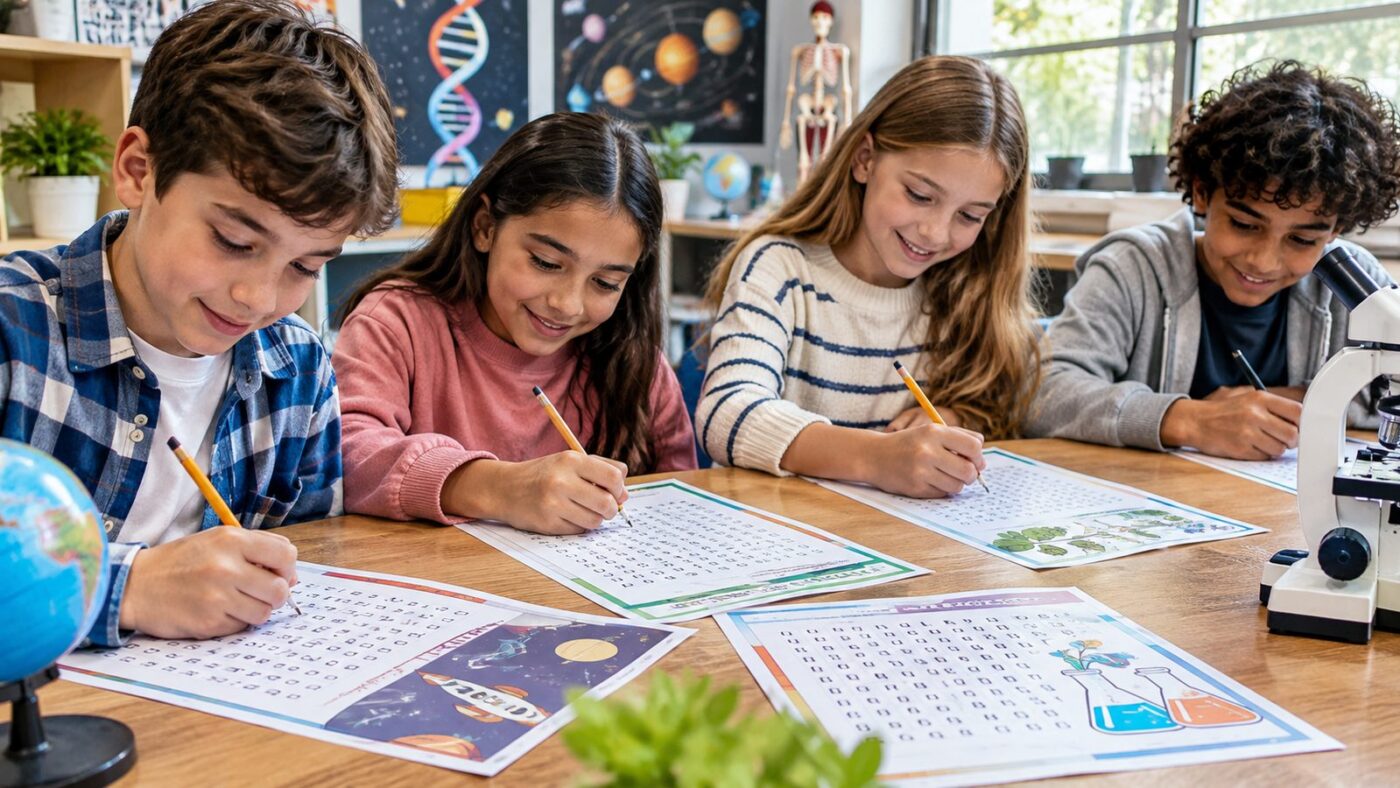
Science becomes easier to explore when children can connect new words with familiar ideas. A science word search gives students a fun way to recognize, spell, and remember important science vocabulary. These four themed activities cover space, the human body, plants and biology, and chemistry and matter. Designed for US students across elementary and middle school, these activities work well in classrooms, homeschool lessons, and family learning sessions. Each theme includes 12 vocabulary words and simple definitions to help children understand what they find.
Table of Contents
Science Word Search Activities at a Glance
| Activity | Main Topic | Suggested Grades | Learning Focus |
|---|---|---|---|
| Space | Astronomy and planets | Grades 2–6 | Space vocabulary |
| Human Body | Anatomy and organs | Grades 3–7 | Body systems |
| Plants and Biology | Living things and plants | Grades 2–7 | Life science |
| Chemistry and Matter | Elements and materials | Grades 4–8 | Physical science |
Quick overview: Students search for science terms, read their definitions, and connect each word with a scientific idea. Teachers and parents can use the activities for vocabulary review, spelling practice, and classroom challenges. The four themes provide different difficulty levels for a range of learning needs.
1. Space
Space introduces children to planets, stars, and the objects beyond Earth. This theme helps students become familiar with astronomy vocabulary while learning about our solar system. It’s a good starting point for elementary science lessons and space-related classroom discussions. Find these 12 space words:
- Planet: A large, nearly round object that travels around a star.
- Galaxy: A huge collection of stars, gas, dust, and other space objects held together by gravity.
- Star: A glowing ball of hot gas that produces its own light and energy.
- Moon: A natural object that travels around a planet.
- Orbit: The curved path one object follows around another in space.
- Asteroid: A small rocky object that travels around the Sun.
- Comet: An icy space object that can develop a glowing tail near the Sun.
- Astronaut: A person trained to travel and work in space.
- Gravity: A force that pulls objects toward one another.
- Telescope: A tool that helps people observe distant objects in space.
- Solar: A word that describes something related to the Sun.
- Universe: Everything that exists, including space, matter, energy, and galaxies.
Space Word Search Grid
Find all 12 words in the grid. Words run left to right, top to bottom, or diagonally.
| Z | O | D | S | O | R | B | I | T | F | M | J | L | S | Q |
|---|---|---|---|---|---|---|---|---|---|---|---|---|---|---|
| P | M | N | J | X | Y | N | A | G | U | O | W | K | I | Q |
| E | X | Y | Z | Y | W | J | S | H | B | W | R | U | F | Y |
| Q | C | P | L | A | N | E | T | R | K | A | Y | N | I | F |
| V | W | E | Z | V | O | T | R | E | T | P | N | I | L | R |
| O | G | C | S | X | H | R | O | S | G | E | G | V | M | F |
| R | R | B | O | H | T | Q | N | K | B | A | Q | E | Q | D |
| D | A | B | L | M | B | F | A | Q | G | N | T | R | Q | B |
| C | V | Q | A | P | E | H | U | E | K | Z | R | S | K | A |
| D | I | M | R | H | I | T | T | F | E | M | K | E | D | A |
| C | T | Y | C | I | L | K | T | T | G | B | B | O | E | M |
| O | Y | H | D | M | O | O | N | S | I | N | T | J | F | G |
| T | E | L | E | S | C | O | P | E | I | X | U | T | W | R |
| T | O | Q | A | S | T | E | R | O | I | D | C | K | U | Z |
| Q | M | A | Y | S | Q | G | A | L | A | X | Y | V | N | J |
Learning extension: Ask students to choose three words after completing the puzzle. They can write one interesting fact about each word or draw a simple space diagram.
2. Human Body
The human body contains many connected parts that help us move, breathe, think, and grow. Learning anatomical vocabulary helps children understand basic body structures and their functions. This activity is suitable for elementary and middle-school health and life science lessons. Find these 12 human body words:
- Brain: The organ that controls thoughts, movement, memory, and many body activities.
- Heart: A muscular organ that pumps blood throughout the body.
- Lungs: Two organs that help the body take in oxygen and release carbon dioxide.
- Muscle: Body tissue that contracts to create movement.
- Skeleton: The framework of bones that supports and protects the body.
- Blood: A fluid that carries oxygen, nutrients, and other substances around the body.
- Nerves: Structures that carry messages between the brain, spinal cord, and body.
- Stomach: An organ that helps break down food during digestion.
- Kidney: An organ that filters waste from the blood and helps make urine.
- Liver: An organ that processes nutrients and helps remove harmful substances.
- Skin: The body’s outer covering, which helps protect it.
- Digest: To break food into smaller substances the body can absorb and use.
Human Body Word Search Grid
Find all 12 words in the grid. Words run left to right, top to bottom, or diagonally.
| T | L | O | K | B | N | P | X | K | J | A | F | G | X | J |
|---|---|---|---|---|---|---|---|---|---|---|---|---|---|---|
| K | S | Q | K | I | I | A | O | S | W | P | G | D | U | L |
| D | D | O | U | W | D | G | O | T | E | H | Y | H | R | I |
| Z | B | I | G | Y | L | N | G | J | V | K | E | P | O | V |
| S | T | S | G | T | R | B | E | S | T | B | K | A | F | E |
| S | U | I | G | E | S | Y | E | Y | T | Z | O | L | R | R |
| F | S | J | K | F | S | V | V | W | K | O | J | W | Y | T |
| X | Q | F | V | C | R | T | S | E | V | B | M | Z | C | B |
| O | Y | Z | B | E | P | M | K | Y | B | R | L | A | Z | K |
| W | V | H | N | P | E | Z | E | C | R | A | B | S | C | E |
| M | U | S | C | L | E | B | L | S | Y | I | G | I | F | H |
| I | F | Y | C | R | W | L | E | X | P | N | P | B | N | U |
| C | W | T | X | O | L | O | T | L | U | B | J | I | P | K |
| L | G | P | X | W | F | O | O | L | H | Y | K | D | Z | M |
| L | D | D | U | C | M | D | N | B | V | S | E | Q | V | Z |
Learning extension: Invite children to match each word with its body part or function. They can also group the words into body systems, such as the digestive, nervous, and respiratory systems.
3. Plants and Biology
Plants and biology introduce students to living organisms and the processes that help them survive. This theme combines plant structures with important life science concepts. Children can learn how plants grow, make food, and interact with their environments. Find these 12 plants and biology words:
- Root: The plant structure that usually grows underground and absorbs water and minerals.
- Stem: The part of a plant that supports leaves and transports water and nutrients.
- Leaf: A plant structure that often captures sunlight for photosynthesis.
- Seed: A plant structure that contains an embryo and can grow into a new plant.
- Flower: A plant structure involved in reproduction in flowering plants.
- Pollen: Fine powder containing the male reproductive cells of seed plants.
- Photosynthesis: The process plants use to make sugars from light, water, and carbon dioxide.
- Chlorophyll: The green pigment that absorbs light energy for photosynthesis.
- Cell: The smallest basic unit of life.
- Organism: An individual living thing, such as a plant, animal, or bacterium.
- Habitat: The natural place where an organism lives.
- Ecosystem: A community of living things interacting with each other and their surroundings.
Plants and Biology Word Search Grid
Find all 12 words in the grid. Words run left to right, top to bottom, or diagonally.
| O | F | S | S | R | R | J | T | Y | F | L | O | W | E | R |
|---|---|---|---|---|---|---|---|---|---|---|---|---|---|---|
| F | S | Q | L | M | O | P | G | V | U | G | L | W | H | L |
| H | D | U | Y | N | Q | O | B | W | F | P | A | J | C | T |
| W | U | L | C | W | V | G | T | I | R | H | Z | W | P | D |
| M | C | C | C | P | F | C | E | L | L | W | V | X | C | R |
| G | P | H | O | T | O | S | Y | N | T | H | E | S | I | S |
| S | W | L | N | H | D | E | C | O | S | Y | S | T | E | M |
| H | X | O | Q | L | I | S | R | K | V | J | U | R | K | F |
| A | F | R | P | C | S | E | E | D | A | P | F | Y | A | B |
| B | O | O | O | P | L | W | L | P | P | Z | T | E | S | R |
| I | V | P | L | Z | J | N | V | Y | M | C | L | G | S | Y |
| T | I | H | L | L | O | R | G | A | N | I | S | M | A | V |
| A | P | Y | E | Z | E | M | F | B | S | F | B | T | F | P |
| T | E | L | N | D | D | P | P | C | T | D | T | P | E | D |
| O | G | L | J | Y | J | K | E | W | Q | W | D | Q | T | M |
Learning extension: Ask students to label a plant diagram using the vocabulary words. They can explain how roots, stems, and leaves work together to support plant growth.
4. Chemistry and Matter
Chemistry helps children understand what materials are made of and how substances behave. This theme introduces basic concepts about atoms, elements, mixtures, and states of matter. It works particularly well for upper elementary and middle-school science classes. Find these 12 chemistry and matter words:
- Atom: The smallest unit of an element that keeps that element’s chemical identity.
- Molecule: A group of two or more atoms held together by chemical bonds.
- Element: A pure substance made of only one type of atom.
- Matter: Anything that has mass and takes up space.
- Solid: A state of matter with a definite shape and volume.
- Liquid: A state of matter with a definite volume but no fixed shape.
- Gas: A state of matter without a fixed shape or volume.
- Mixture: Two or more substances combined without forming a new chemical substance.
- Solution: A uniform mixture in which one or more substances dissolve in another.
- Density: The amount of mass in a given volume of a substance.
- React: To undergo a chemical change with another substance or substances.
- Evaporation: The process in which a liquid changes into a gas at its surface.
Chemistry and Matter Word Search Grid
Find all 12 words in the grid. Words run left to right, top to bottom, or diagonally.
| C | F | P | M | A | T | T | E | R | Q | F | U | S | W | C |
|---|---|---|---|---|---|---|---|---|---|---|---|---|---|---|
| T | H | X | U | V | P | M | T | Q | Y | B | V | Z | M | M |
| X | A | T | J | L | I | O | M | C | Q | A | L | Z | G | Y |
| W | L | S | E | A | O | L | I | U | S | K | K | H | T | N |
| V | I | H | L | L | K | E | X | V | J | W | Z | I | O | D |
| Q | Q | B | E | H | Q | C | T | O | Q | Z | S | I | I | X |
| N | U | S | M | W | K | U | U | A | B | N | T | L | A | T |
| Y | I | O | E | B | M | L | R | C | E | A | O | I | T | J |
| V | D | L | N | S | P | E | E | D | R | S | Q | Q | O | S |
| Z | K | U | T | G | P | F | W | O | P | X | E | C | M | L |
| J | Z | T | L | J | C | W | P | R | E | A | C | T | R | D |
| B | N | I | T | Z | X | A | V | N | U | X | I | S | A | L |
| S | Q | O | P | O | V | E | G | J | V | S | P | O | Z | C |
| I | H | N | Y | E | H | L | U | V | A | E | J | R | K | Y |
| W | N | C | Q | H | Y | M | J | G | M | X | N | U | V | O |
Learning extension: Ask students to identify examples of solids, liquids, and gases around their homes or classrooms. They can also explain how melting, freezing, and evaporation change the state of matter.
How to Use a Science Word Search in the Classroom
A word search works best when students understand the vocabulary rather than only locating hidden letters. Introduce the topic before distributing the activity, especially when children encounter unfamiliar scientific terms. This approach connects spelling practice with the science concepts being taught. Here are five practical ways to use these activities:
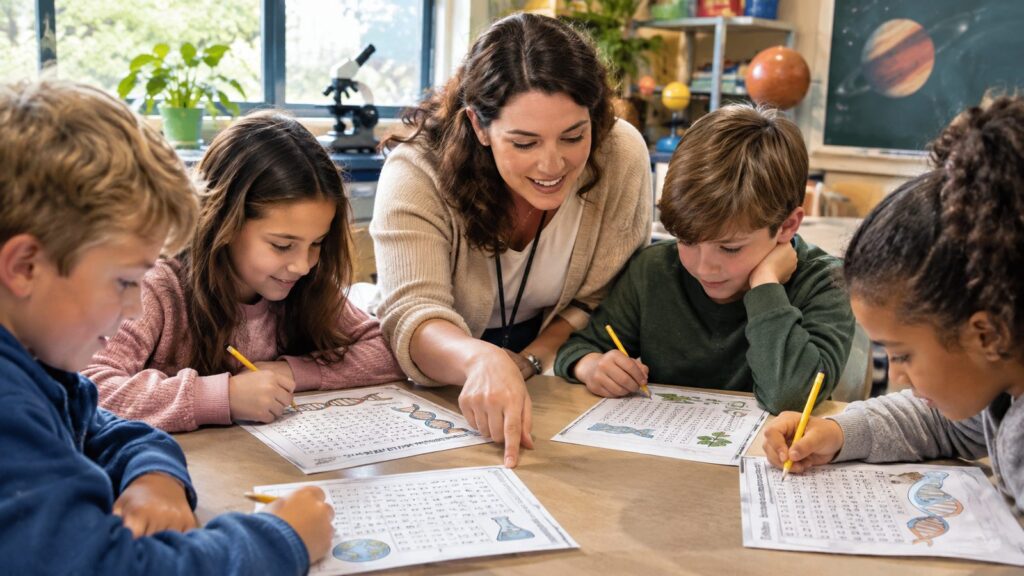
- Vocabulary introduction: Read the 12 words aloud and discuss their meanings before students begin.
- Independent practice: Let students complete a puzzle during science review or independent learning time.
- Partner challenges: Pair students and ask them to take turns finding and explaining words.
- Definition matching: Have students match every vocabulary word with its correct definition.
- Sentence writing: Ask children to use five discovered words in original science-related sentences.
Teachers can also use these activities as classroom centers or early-finisher assignments. Students who finish quickly can research one unfamiliar term and share what they learn. This gives the activity an additional reading and comprehension component. Puzzles also build focus and memory, as this look at how puzzle games help improve your brain explains.
Difficulty Variations by US Grade Level
Students develop vocabulary and reading skills at different rates. Adjusting word lists and puzzle layouts helps make the same science theme useful across several grades. The following suggestions provide a flexible starting point for US classrooms.
| Grade Level | Recommended Difficulty | Suggested Adjustments |
|---|---|---|
| Kindergarten, Grade 1 | Beginner | Use 5–8 short words and simple definitions. |
| Grades 2–3 | Easy | Use familiar terms and smaller grids. |
| Grades 4–5 | Intermediate | Include all 12 words and longer vocabulary. |
| Grades 6–8 | Advanced | Add longer terms and diagonal or backward placements. |
For younger students: Choose short words such as moon, star, leaf, and cell. Keep the grids small and use large, readable letters. For Grades 2–3: Introduce familiar science vocabulary and simple definitions. Encourage students to read each word aloud before searching. For Grades 4–5: Include more detailed terms such as gravity, ecosystem, photosynthesis, and molecule. Add definition-matching exercises after the puzzle. For Grades 6–8: Use longer scientific vocabulary and more challenging letter placements. Ask students to explain how related terms connect to broader scientific concepts. Teachers should adjust difficulty according to reading ability and previous science instruction. Grade levels are useful guides, but individual students may need different levels of support.
Teacher and Parent Tips for Better Vocabulary Practice
Parents and teachers can turn these activities into short learning sessions without making them feel like formal tests. A few simple follow-up exercises help children understand and remember unfamiliar terms. Consistent practice also gives students opportunities to use scientific language in everyday conversations. For broader study habits, see these ideas on smarter learning for brighter futures. Try these activities after completing a puzzle: 1. Use timed challenges Set a reasonable time limit for finding all 12 words. Younger students may need more time, while older children can try shorter challenges. Focus on accuracy and understanding rather than speed alone. 2. Practice vocabulary recall Cover the definitions and ask students to explain each word in their own language. They can also write the meanings from memory and check their answers afterward. This encourages active recall instead of relying only on recognition. 3. Create word categories Ask children to organize the discovered terms into related groups. For example, space students can separate planets, space objects, and observation tools. Chemistry students can group vocabulary into atoms, materials, and changes of state. 4. Encourage science conversations Choose two or three words and ask children to explain how they relate. For example, discuss how roots, stems, and leaves support a plant. These conversations help connect individual definitions with larger scientific ideas. 5. Connect vocabulary with everyday examples Use familiar objects to explain abstract concepts. Water, ice, and steam provide useful examples when discussing states of matter. A houseplant can help children identify roots, stems, leaves, and photosynthesis.
Answer Key for All Four Puzzles
Each answer gives the row and column of the first letter, counting rows from the top and columns from the left, starting at 1. Directions are right, down, down-right, or up-right.
Space Answers
| Word | Start (Row, Column) | Direction |
|---|---|---|
| PLANET | Row 4, Column 3 | right |
| GALAXY | Row 15, Column 7 | right |
| STAR | Row 6, Column 9 | up-right |
| MOON | Row 12, Column 5 | right |
| ORBIT | Row 1, Column 5 | right |
| ASTEROID | Row 14, Column 4 | right |
| COMET | Row 6, Column 3 | down-right |
| ASTRONAUT | Row 2, Column 8 | down |
| GRAVITY | Row 6, Column 2 | down |
| TELESCOPE | Row 13, Column 1 | right |
| SOLAR | Row 6, Column 4 | down |
| UNIVERSE | Row 3, Column 13 | down |
Human Body Answers
| Word | Start (Row, Column) | Direction |
|---|---|---|
| BRAIN | Row 8, Column 11 | down |
| HEART | Row 3, Column 11 | down-right |
| LUNGS | Row 14, Column 9 | up-right |
| MUSCLE | Row 11, Column 1 | right |
| SKELETON | Row 8, Column 8 | down |
| BLOOD | Row 11, Column 7 | down |
| NERVES | Row 10, Column 4 | up-right |
| STOMACH | Row 5, Column 9 | down-right |
| KIDNEY | Row 1, Column 4 | down-right |
| LIVER | Row 2, Column 15 | down |
| SKIN | Row 15, Column 11 | up-right |
| DIGEST | Row 3, Column 2 | down-right |
Plants and Biology Answers
| Word | Start (Row, Column) | Direction |
|---|---|---|
| ROOT | Row 1, Column 5 | down-right |
| STEM | Row 12, Column 12 | down-right |
| LEAF | Row 11, Column 12 | up-right |
| SEED | Row 9, Column 6 | right |
| FLOWER | Row 1, Column 10 | right |
| POLLEN | Row 9, Column 4 | down |
| PHOTOSYNTHESIS | Row 6, Column 2 | right |
| CHLOROPHYLL | Row 5, Column 3 | down |
| CELL | Row 5, Column 7 | right |
| ORGANISM | Row 12, Column 6 | right |
| HABITAT | Row 8, Column 1 | down |
| ECOSYSTEM | Row 7, Column 7 | right |
Chemistry and Matter Answers
| Word | Start (Row, Column) | Direction |
|---|---|---|
| ATOM | Row 7, Column 14 | down |
| MOLECULE | Row 2, Column 7 | down |
| ELEMENT | Row 4, Column 4 | down |
| MATTER | Row 1, Column 4 | right |
| SOLID | Row 9, Column 11 | up-right |
| LIQUID | Row 4, Column 2 | down |
| GAS | Row 15, Column 9 | up-right |
| MIXTURE | Row 3, Column 8 | down |
| SOLUTION | Row 7, Column 3 | down |
| DENSITY | Row 9, Column 9 | up-right |
| REACT | Row 11, Column 9 | right |
| EVAPORATION | Row 14, Column 5 | up-right |
Frequently Asked Questions
What is a science word search?
A science word search is a vocabulary puzzle containing hidden words related to scientific subjects. Students locate the words within a grid of letters and learn their meanings. It combines spelling practice, reading, and introductory science learning.
How can teachers use science word search activities?
Teachers can use these puzzles during science lessons, vocabulary reviews, and independent practice sessions. They also work well as partner activities and classroom learning centers. Adding definition matching or sentence writing helps reinforce the scientific concepts.
Are these activities suitable for elementary school students?
Yes, the four themes can support elementary students from approximately Grades 2–5. Teachers can simplify the word lists and puzzle layouts for younger learners. Older students can use the same vocabulary with more challenging grids and additional research tasks.
How many words should a children’s science puzzle contain?
A list of 10–12 words is a useful starting point for many elementary activities. Shorter lists can help beginners, while older students may enjoy longer lists. The ideal number depends on reading ability, vocabulary difficulty, and available classroom time.
Can parents use these puzzles for homeschooling?
Yes, parents can incorporate the activities into homeschool science lessons and weekly vocabulary practice. Each theme offers opportunities for discussion, reading, and simple research. Parents can also ask children to find examples of the vocabulary in everyday life.
How can students learn science vocabulary after solving a puzzle?
Students can write definitions, draw diagrams, or create sentences using the discovered words. They can also group related terms and explain how they connect. These follow-up activities help turn word recognition into meaningful vocabulary understanding.
Make Science Vocabulary Practice Fun
Science learning doesn’t have to rely entirely on textbooks and written exercises. Vocabulary puzzles give children another way to recognize scientific terms and explore their meanings. With four different themes, students can practice concepts from astronomy, anatomy, biology, and chemistry. Parents can use these activities during homeschool sessions or quiet learning time. Teachers can include them in classroom centers, lesson reviews, and group challenges. Choose an appropriate difficulty level, encourage students to discuss unfamiliar words, and make each puzzle an opportunity to learn something new. —